Showing posts with label Drama. Show all posts

Sunday, August 16, 2009

Amadeus


Happy people are pleased by the happiness of others. The miserable are poisoned by envy. They vote with Gore Vidal and David Merrick, both credited with saying, "It is not enough that I succeed. Others must fail." Milos Forman's "Amadeus" is not about the genius of Mozart but about the envy of his rival Salieri, whose curse was to have the talent of a third-rate composer but the ear of a first-rate music lover, so that he knew how bad he was, and how good Mozart was.

The most moving scene in the movie takes place at Mozart's deathbed, where the great composer, only 35, dictates the final pages of his great "Requiem" to Salieri, sitting at the foot of the bed with quill and manuscript, dragging the notes from Mozart's fevered brain. This scene is moving not because Mozart is dying, but because Salieri, his lifelong rival, is striving to extract from the dying man yet another masterpiece that will illuminate how shabby Salieri's work is. Salieri hates Mozart but loves music more, and cannot live without yet one more work that he can resent for its perfection. True, Salieri plans to claim the work as his own--but for a man like him, that will be one more turn of the screw.


"Amadeus" (1984) swept the Academy Awards and had a considerable popular success. When you consider that 98 percent of the American public never listens to a classical music station, it is astonishing that Mozart became for a time a best-seller, and not only to women assured by talk-show gurus that his music boosted the IQs of embryos. The movie's success is partly explained, I think, by its strategy of portraying Mozart not as a paragon whose greatness is a burden to us all, but as a goofy proto-hippie with a high-pitched giggle, an overfondness for drink, and a buxom wife who liked to chase him on all fours.

This is not a vulgarization of Mozart, but a way of dramatizing that true geniuses rarely take their own work seriously, because it comes so easily for them. Great writers (Nabokov, Dickens, Wodehouse) make it look like play. Almost-great writers (Mann, Galsworthy, Wolfe) make it look like Herculean triumph. It is as true in every field; compare Shakespeare to Shaw, Jordan to Barkley, Picasso to Rothko, Kennedy to Nixon. Salieri could strain and moan and bring forth tinkling jingles; Mozart could compose so joyously that he seemed, Salieri complained, to be "taking dictation from God."


"Amadeus" was brought forth by the independent producer Saul Zaentz ("One Flew Over the Cuckoo's Nest," "Unbearable Lightness of Being," "The English Patient"), who brought Peter Shaffer's play and assigned the playwright to adapt it with the director Milos Forman. Zaentz's pattern, as you can see, is to take literary successes that seem unfilmable--too ambitious, too specialized--and film them. Forman, a Czech filmmaker who turned his back on the Russians and came to work in America, but not exactly in Hollywood, had directed "Cuckoo's Nest" (1975), "Hair" (1981) and "Ragtime" (1984).

The key precursor is "Hair." He sees Wolfgang Amadeus Mozart as a spiritual brother of the hippies who thumbed their noses at convention, muddled their senses with intoxicants, and delighted in lecturing their elders. In a film where everybody wears wigs, Mozart's wigs (I noted in my original review) do not look like everybody else's. They have just the slightest suggestion of punk, just the smallest shading of pink. There is something about Mozart's Vienna apartment, especially toward the end, that reminds you of the pad of a newly-rich rock musician: The rent is sky-high, the furnishings are sparse and haphazard, work is scattered everywhere, housekeeping has been neglected, there are empty bottles in the corners, and the bed is the center of life.


The flower child Mozart tries to govern his life, unsuccessfully, by the lights of three older men. His father Leopold (Roy Dotrice) trained the child genius to amaze the courts of Europe, but now stands aside, disapproving, at the untidy mess Mozart has made of his adulthood. His patron, Emperor Joseph II (Jeffrey Jones) passes strict rules (no ballet in operas!) but cannot enforce them because, God love him, he enjoys what he would forbid. Then there is Salieri (F. Murray Abraham), who poses as his friend while plotting against him, sabotaging productions, blocking appointments. The irony (not least to Salieri) is that Salieri is honored and admired while Mozart is so new and unfamiliar that no one knows how good he is, except Salieri. Even the emperor, who indulges him, is as amused by Mozart's insolence as by his art. Mozart's role in the court of Joseph II is as the fool, saying truth wrapped in giggles. Mozart's ally in his struggles with authority is his wife Constanze (Elizabeth Berridge), who seems a child, stays too late in bed, calls him "Wolfie," but yet has a good head for business and a sharp eye for treachery.

The film is told in flashback by Salieri at the end of his life, confined in a madhouse, confiding to a young priest. He thinks perhaps he killed Mozart. It is more likely Mozart killed himself, by some deadly cocktail of tuberculosis and cirrhosis, but Salieri seems to have killed Mozart's art, and for that he feels remorse. It is all there in Mozart's deathbed scene: The agony of the older rival who hates to lose, who would lie and betray, and yet cannot deny that the young man's music is sublime.

The movie was shot on location in Forman's native Prague, one of a handful of European cities still in large parts unchanged since the 18th century. The film is a visual feast of palaces, costumes, wigs, feasts, opening nights, champagne, and mountains of debt. Mozart never had enough money, or much cared; Salieri had money, but look at his face when people snicker behind his back while he plays one of his compositions, and you will see what small consolation it was.

"Director's cuts" are a mixed blessing in this age of the DVD. Many of them seem inspired entirely by the desire to sell another video. Forman says his new version of "Amadeus," which runs 20 minutes longer than the 1984 version, is in fact the original cut: Afraid that a historical biopic about Mozart would find tough sailing at the box office, Forman and Zaentz made trims for pragmatic reasons. The major addition to the film is a scene explaining more fully why Constanze has such contempt for Salieri. Salieri, the court composer, has in his gift a lucrative appointment that, he explains to the young bride, will be her husband's--if she will grant Salieri her favors. Since there is little indication that Salieri has any great interest in women (or in anything, other than Mozart) this favor seems motivated not by sexual desire but by the need to humiliate Mozart. Constanze, desperate to help her Wolfie, does indeed visit Salieri at his apartments, and bares her breasts before having second thoughts.

In a film of grand gestures, some of the finest moments are very subtle. Notice the way Jeffrey Jones, as the emperor, balances his duty to appear serious and his delight in Mozart's impudence. Watch Jones' face as he decides he may have been wrong to ban ballet from opera. And watch Abraham's face as he internalizes envy, resentment and rage. What a smile he puts on the face of his misery! Then watch his face again at Mozart's deathbed, as he takes the final dictation. He knows how good it is. And he knows at that moment there is only one thing he loves more than himself, and that is Mozart's music.

Friday, August 7, 2009

Breathless


When we talked, I talked about me, you talked about you, when we should have talked about each other.
--Michel to Patricia

Modern movies begin here, with Jean-Luc Godard's "Breathless" in 1960. No debut film since "Citizen Kane" in 1942 has been as influential. It is dutifully repeated that Godard's technique of "jump cuts" is the great breakthrough, but startling as they were, they were actually an afterthought, and what is most revolutionary about the movie is its headlong pacing, its cool detachment, its dismissal of authority, and the way its narcissistic young heroes are obsessed with themselves and oblivious to the larger society.

There is a direct line through "Breathless" to "Bonnie and Clyde," "Badlands" and the youth upheaval of the late 1960s. The movie was a crucial influence during Hollywood's 1967-1974 golden age. You cannot even begin to count the characters played by Pacino, Beatty, Nicholson, Penn, who are directly descended from Jean-Paul Belmondo's insouciant killer Michel.

"Breathless" remains a living movie that retains the power to surprise and involve us after all these years. What fascinates above all is the naivete and amorality of these two young characters: Michel, a car thief who idolizes Bogart and pretends to be tougher than he is, and Patricia (Jean Seberg), an American who peddles the Paris edition of the New York Herald-Tribune while waiting to enroll at the Sorbonne. Do they know what they're doing? Both of the important killings in the movie occur because Michel accidentally comes into possession of someone else's gun; Patricia's involvement with him seems inspired in equal parts by affection, sex and fascination with his gangster persona.

Michel wants to be as tough as the stars in the movies he loves. He practices facial expressions in the mirror, wears a fedora, and is never, ever seen without a cigarette, removing one from his mouth only to insert another. So omnipresent is this cigarette that Godard is only kidding us a little when Michel's dying breath is smoky. But Belmondo at 26 still had a little of the adolescent in him, and the first time we see him, his hat and even his cigarette seem too big for his face. He was "hypnotically ugly," Bosley Crowther wrote in his agitated New York Times review, but that did not prevent him from becoming the biggest French star between Jean Gabin and Gerard Depardieu.

Seberg was restarting her career after its disastrous launch in America. Otto Preminger staged a famous talent search for the star of his "Saint Joan" (1957), and cast an inexperienced 18-year-old Marshalltown, Iowa, girl; Seberg received terrible reviews, not entirely deserved, and more bad notices for "Bonjour Tristesse" (1958), which Preminger made next to prove himself right. She fled to Europe, where she was only 21 when Godard cast her for "Breathless."

Her Patricia is the great enigma of the movie. Michel we can more or less read at sight: He postures as a gangster, maintains a cool facade, is frightened underneath. His persona is a performance that functions to conceal his desperation. But what about Patricia? Somehow it is never as important as it should be that she thinks she is pregnant, and that Michel is the father. She receives startling items of information about Michel (that he is a killer, that he is married, that he has more than one name) with such apparent detachment that we study that perfectly molded gamin face and wonder what she can possibly be thinking. Even her betrayal of him turns out to be not about Michel, and not about right and wrong, but only a test she sets for herself to determine if she loves him or not. It is remarkable that the reviews of this movie do not describe her as a monster--more evil, because she's less deluded, than Michel.

The filming of "Breathless" has gathered about it a body of legend. It was one of the key films of the French New Wave, which rejected the well-made traditional French cinema and embraced a rougher, more experimental personal style. Many of the New Wave directors began as critics for the anti-establishment magazine Cahiers du Cinema. The credits for "Breathless" are a New Wave roll call, including not only Godard's direction but an original story by Francois Truffaut (Godard famously wrote each day's shooting script in the morning). Claude Chabrol is production designer and technical adviser, the writer Pierre Boulanger plays the police inspector, and there are small roles for Truffaut and Godard himself (as the informer). Everyone was at the party; the assistant director was Pierre Rissient, who wears so many hats he is most simply described as knowing more people in the cinema than any other single person.

Jean-Pierre Melville, whose own crime movies in the 1950s pointed the way to the New Wave, plays the writer interviewed by Patricia at Orly, where he expounds on life and sex ("Two things are important in life. For men, women. For women, money"). Melville's "Bob Le Flambeur" (1955) is referenced when we meet the man who informed on Bob, or when Michel tells a friend, "Bob the gambler would have cashed my check."

One inside joke in the film is always mentioned, but is not really there. Michel's alias is "Laszlo Kovacs," and countless writers inform us this is a reference to the legendary Hungarian cinematographer. In fact, Godard had not met Kovacs at the time, and the reference is to the character Belmondo played in Chabrol's "A Double Tour" (1959). In a film with so many references to the past of the cinema, it is amusing to find a coincidental reference to its future.

Godard's key collaborator on the film was the cinematographer Raoul Coutard, who worked with him many times, notably on "Weekend" (1967). It was only Coutard's fourth film, and his methods became legend: How when they could not afford tracks for a tracking shot, he held the camera and had himself pushed in a wheelchair. How he achieved a grainy look that influenced many other fiction films that wanted to seem realistic. How he scorned fancy lighting. How he used hand-held techniques even before lightweight cameras were available. How he timed one shot of Belmondo so that the streetlights on the Champs Elysses came on behind him. There is a lovely backlit shot of Belmondo in bed and Seberg sitting beside the bed, both smoking, the light from the window enveloping them in a cloud.

That's from a long scene that's alive with freshness and spontaneity. Patricia returns home to find Michel in her bed, and they talk, flirt, smoke, fight, finally make love. She quotes Faulkner: "Between grief and nothing, I will take grief." Michel says he would choose nothing; "grief is a compromise." She poses in front of a Renoir poster of a young girl, and asks who is prettier. Michel sits below a Picasso poster of a man holding a mask. Throughout this long scene, perplexingly, they both throw their discarded cigarettes out the window.

In this scene and throughout the film, Godard uses jump cuts--cuts within continuous movement or dialogue, with no attempt made to make them match. The technique "was a little more accidental than political," writes the Australian critic Jonathan Dawson. The finished film was 30 minutes too long, and "rather than cut out whole scenes or sequences, Godard elected to trim within the scene, creating the jagged cutting style still so beloved of action filmmakers. Godard just went at the film with the scissors, cutting out anything he thought boring."

The technique adds charm to a scene where the two drive through Paris in a stolen convertible, and there is a series of closeup cuts over her shoulder as Michel describes her. When the two lovers, fleeing the police, sneak into a movie, it is a scene directly quoted in "Bonnie and Clyde"--which, we recall, both Godard and Truffaut were once to direct. In each case, the dialogue reflects the action; Bonnie and Clyde hear "we're in the money," and Michel and Patricia hear dialogue about a woman "covering up for a cheap parasite."

The movie had a sensational reception; it is safe to say the cinema was permanently changed. Young directors saw it and had abandoned their notions of the traditional studio film before they left the theater. Crowther of the Times, who was later to notoriously despise its descendant "Bonnie and Clyde," said of "Breathless" that "sordid is really a mild word for its pile-up of gross indecencies." The jump cuts to him were "pictorial cacophony."

Yet Crowther conceded, "It is no cliche," and the film's bold originality in style, characters and tone made a certain kind of genteel Hollywood movie quickly obsolete. Godard went on to become the most famous innovator of the 1960s, although he lost the way later, with increasingly mannered experiments. Here in one quick, sure move, knowing somehow just what he wanted and how to obtain it, he achieved a turning point in the cinema just as surely as Griffith did with "Birth of a Nation" and Welles with "Citizen Kane."

Thursday, August 6, 2009

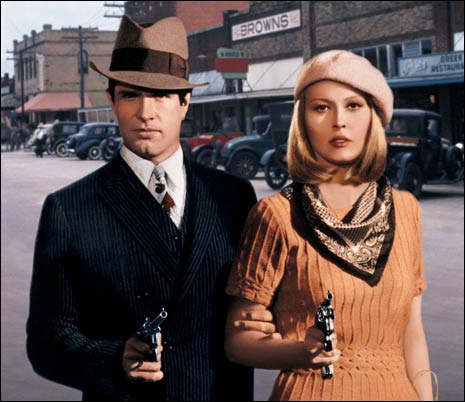
Bonnie and Clyde


There is a moment in "Bonnie and Clyde'' when Bonnie, frightened and angry, runs away from Clyde through a field of wheat, and as he pursues her, a cloud sweeps across the field and shadows them. Seen in a high, wide-angle shot, it is one of those moments of serendipity given to few movies. Today the cloud could be generated by computers; on the day the scene was filmed in Texas, it was a perfectly timed accident of nature.

The cloud carries foreboding; Bonnie and Clyde are doomed, and uneasily realize it. Not long after that scene, Bonnie has a final reunion with her mother. By then Bonnie Parker (Faye Dunaway) and Clyde Barrow (Warren Beatty) are famous outlaws, celebrated in the press as populist bank robbers in an America gripped by the Depression. Bonnie speaks wistfully of marrying Clyde and moving in next door to her mother. "You live within a mile of me, honey, and you'll be dead,'' her mother flatly pronounces.

They would indeed die, in a hail of bullets that permanently changed the way the movies depicted violence. But their lives provided a template that would be used time and again in later films; as the ads put it, "They're young ... they're in love ... and they kill people.'' From "Bonnie and Clyde'' descended "Badlands,'' "Days of Heaven,'' "Thelma & Louise,'' "Drugstore Cowboy,'' "Natural Born Killers'' and countless other movies in which ordinary people were transformed by sudden violence into legend.

"Bonnie and Clyde,'' made in 1967, was called "the first modern American film'' by critic Patrick Goldstein, in an essay on its 30th anniversary. Certainly it felt like that at the time. The movie opened like a slap in the face. American filmgoers had never seen anything like it. In tone and freedom it descended from the French new wave, particularly Francois Truffaut's own film about doomed lovers, "Jules and Jim.'' Indeed, it was Truffaut who first embraced the original screenplay by David Newman and Robert Benton, and called it to the attention of Warren Beatty, who was determined to produce it.

The legend of the film's production has become almost as famous as its heroes. Stories are told about how Beatty knelt at the feet of studio boss Jack Warner, begging for the right to make the film. How Warner saw the original cut and hated it. How the movie premiered at the Montreal film festival, and was roasted by Bosley Crowther of the New York Times. How Warner Bros. determined to dump it in a chain of Texas drive-ins, and how Beatty implored the studio to give it a chance.

How it opened and quickly closed in the autumn of 1967, panned by the critics, receiving only one ecstatic opening-day newspaper review. (Modesty be damned: It was my own, calling it "a milestone in the history of American movies, a work of truth and brilliance'' and predicting "years from now it is quite possible that `Bonnie and Clyde' will be seen as the definitive film of the 1960s.'')

The movie closed, but would not go away. The soundtrack, bluegrass by Flatt and Scruggs, went to the top of the charts. Theodora Van Runkle's berets and maxiskirts for Dunaway started a global fashion craze. Newsweek critic Joseph Morgenstern famously wrote that his original negative review had been mistaken. The movie reopened, went on to become one of Warner Bros.' biggest hits and won 10 nominations (with Oscars for supporting actress Estelle Parsons and cinematographer Burnett Guffey).

But that is only the success story. More important was the impact the film had on the American movie industry. Beatty's willingness to play a violent character with sexual dysfunction was unusual for a traditional 1960s leading man. In a famous Esquire profile by Rex Reed, which appeared as the movie was opening, he was dismissed as a has-been pretty boy. "Bonnie and Clyde'' put him permanently on the Hollywood map.

Beatty and director Arthur Penn cast the movie mostly with unknown stage actors--so successfully that all the major players (Dunaway, Parsons, Gene Hackman, Michael J. Pollard, Gene Wilder) became stars on the basis of this film. Behind the camera, the movie launched the careers not only of Van Runkle, but also of editor Dede Allen (a New Yorker breaking into a closed shop) and production designer Dean Tavoularis, who went on to work on Francis Ford Coppola's "The Godfather'' and "Apocalypse Now.'' And the cinematography of Guffey launched a whole new wave of its own, of films shot and edited in the more impressionistic French style.

Arthur Penn came fresh to the project after a resounding failure ("Mickey One,'' a self-conscious but intriguing art film) also made with Beatty. His later credits included "Night Moves,'' "Alice's Restaurant'' and "Little Big Man.'' Co-writer Robert Benton became an important director ("Kramer vs. Kramer,'' "Places in the Heart''). It's as if that one film sent all those careers cascading down to the present day.

It was a film in which all of the unlikely pieces were assembled at the right time. And more than anything else, it was a masterpiece of tone, in which the actors and filmmakers were all in sync as they moved the material back and forth between comedy and tragedy.

The opening scenes are lighthearted, starting with Clyde's bravado after Bonnie catches him trying to steal her mother's car. She senses in him, instantly, the means of her escape from a boring west Texas town. What he essentially supplies--for her, for the hero-worshipping gang member C.W. Moss (Pollard) and for the hungry newspaper readers -- is the possibility of glamour in lives of drab poverty. "We're the Barrow Gang,'' Clyde says, introducing them at the beginning of a bank robbery so they'll be sure to get credit. And one of the movie's great moments comes as Clyde lends his gun to a dispossessed black sharecropper so he could shoot at a bank's foreclosure sign.

If Clyde offers glamour, Bonnie offers publicity. She writes "The Ballad of Bonnie and Clyde'' and sends it to a newspaper, and she poses for photos holding a machinegun and a cigar. Clyde's brother Buck (Hackman) is more level-headed, more concerned with bank jobs than newspaper headlines. He comes attached to Blanche (Parsons), whose whiny complaints get on Bonnie's nerves (when agents surround one of their hideouts, she runs screaming across the lawn, still holding the spatula she was using to cook supper).

Penn directs the film as a series of set-pieces, which remain in the memory, focused and clear. The Okie camp where homeless farmers, tractored off their lands by the banks, hunch over campfires. Bonnie's sad, overcast, foggy family reunion. The bank robbery that goes all wrong when C.W. stupidly parks the getaway car. The way laughter turns blindingly to violence, as when a stickup ends with a meat cleaver and a sack of flour, or when a getaway ends with a bullet in a bank man's face. The run-in with a state trooper (Denver Pyle) who is made to pose with Bonnie and Clyde, and then unwisely released. The scene where C.W., a gas station attendant, leaves his job and runs off with the gang that's just robbed him. The scene where C.W.'s father effortlessly browbeats his wimpy son for getting a tattoo. And then the slow-motion ballet of the final execution.

Today, the freshness of "Bonnie and Clyde'' has been absorbed in countless other films, and it's hard to see how fresh and original it felt in 1967 -- just as the impact of "Citizen Kane,'' in 1941, may not be obvious to those raised in the shadow of its influence.

When I saw it, I had been a film critic for less than six months, and it was the first masterpiece I had seen on the job. I felt an exhilaration beyond describing. I did not suspect how long it would be between such experiences, but at least I learned that they were possible.

Wednesday, August 5, 2009

Gone With The Wind


"Gone With the Wind'' presents a sentimental view of the Civil War, in which the ``Old South'' takes the place of Camelot and the war was fought not so much to defeat the Confederacy and free the slaves as to give Miss Scarlett O'Hara her comeuppance. But we've known that for years; the tainted nostalgia comes with the territory. Yet as ``GWTW'' approaches its 60th anniversary, it is still a towering landmark of film, quite simply because it tells a good story, and tells it wonderfully well.

For the story it wanted to tell, it was the right film at the right time. Scarlett O'Hara is not a creature of the 1860s but of the 1930s: a free-spirited, willful modern woman. The way was prepared for her by the flappers of Fitzgerald's jazz age, by the bold movie actresses of the period, and by the economic reality of the Depression, which for the first time put lots of women to work outside their homes.

Scarlett's lusts and headstrong passions have little to do with myths of delicate Southern flowers, and everything to do with the sex symbols of the movies that shaped her creator, Margaret Mitchell: actresses such as Clara Bow, Jean Harlow, Louise Brooks and Mae West. She was a woman who wanted to control her own sexual adventures, and that is the key element in her appeal. She also sought to control her economic destiny in the years after the South collapsed, first by planting cotton and later by running a successful lumber business. She was the symbol the nation needed as it headed into World War II; the spiritual sister of Rosie the Riveter.

Of course, she could not quite be allowed to get away with marrying three times, coveting sweet Melanie's husband Ashley, shooting a plundering Yankee, and banning her third husband from the marital bed in order to protect her petite waistline from the toll of childbearing. It fascinated audiences (it fascinates us still) to see her high-wire defiance in a male chauvinist world, but eventually such behavior had to be punished, and that is what ``Frankly, my dear, I don't give a damn'' is all about. If ``GWTW'' had ended with Scarlett's unquestioned triumph, it might not have been nearly as successful. Its original audiences (women, I suspect, even more than men) wanted to see her swatted down--even though, of course, tomorrow would be another day.

Rhett Butler was just the man to do it. As he tells Scarlett in a key early scene, ``You need kissing badly. That's what's wrong with you. You should be kissed, and often, and by someone who knows how.'' For ``kissed,'' substitute the word you're thinking of. Dialogue like that reaches something deep and fundamental in most people; it stirs their fantasies about being brought to sexual pleasure despite themselves. (``Know why women love the horse whisperer?'' I was asked by a woman friend not long ago. ``They figure, if that's what he can do with a horse, think what he could do with me.'') Scarlett's confusion is between her sentimental fixation on a tepid ``Southern gentleman'' (Ashley Wilkes) and her unladylike lust for a bold man (Rhett Butler). The most thrilling struggle in ``GWTW'' is not between North and South, but between Scarlett's lust and her vanity.

Clark Gable and Vivien Leigh were well matched in the two most coveted movie roles of the era. Both were well-served by a studio system that pumped out idealized profiles and biographies, but we now know what outlaws they were: Gable, the hard-drinking playboy whose studio covered up his scandals; Leigh, the neurotic, drug-abusing beauty who was the despair of every man who loved her.

They brought experience, well-formed tastes and strong egos to their roles, and the camera, which cannot lie and often shows more than the story intends, caught the flash of an eye and the readiness of body language that suggested sexual challenge. Consider the early scene where they first lay eyes on one another during the barbecue at Twelve Oaks. Rhett ``exchanges a cool, challenging stare with Scarlett,'' observes the critic Tim Dirks. ``She notices him undressing her with his eyes: `He looks as if--as if he knows what I look like without my shimmy.' ''

If the central drama of ``Gone With the Wind'' is the rise and fall of a sexual adventuress, the counterpoint is a slanted but passionate view of the Old South. Unlike most historical epics, ``GWTW'' has a genuine sweep, a convincing feel for the passage of time. It shows the South before, during and after the war, all seen through Scarlett's eyes. And Scarlett is a Southerner. So was Margaret Mitchell. The movie signals its values in the printed narration that opens the film, in language that seems astonishing in its bland, unquestioned assumptions:

``There was a land of Cavaliers and Cotton Fields called the Old South. Here in this pretty world, Gallantry took its last bow. Here was the last ever to be seen of Knights and their Ladies Fair, of Master and of Slave. Look for it only in books, for it is no more than a dream remembered, a Civilization gone with the wind.''

Yes, with the capital letters and all. One does not have to ask if the Slaves saw it the same way. The movie sidesteps the inconvenient fact that plantation gentility was purchased with the sweat of slaves (there is more sympathy for Scarlett getting calluses on her pretty little hands than for all the crimes of slavery). But to its major African-American characters it does at least grant humanity and complexity. Hattie McDaniel, as Mammy, is the most sensible and clear-sighted person in the entire story (she won one of the film's eight Oscars), and although Butterfly McQueen, as Prissy, will always be associated with the line ``I don't know nothin' about birthin' babies,'' the character as a whole is engaging and subtly subversive.

Remember that when ``GWTW'' was made, segregation was still the law in the South and the reality in the North. That the Ku Klux Klan was written out of one scene for fear of giving offense to elected officials who belonged to it. The movie comes from a world with values and assumptions fundamentally different from our own--and yet, of course, so does all great classic fiction, starting with Homer and Shakespeare. A politically correct ``GWTW'' would not be worth making, and might largely be a lie.

As an example of filmmaking craft, ``GWTW'' is still astonishing. Several directors worked on the film; George Cukor incurred Clark Gable's dislike and was replaced by Victor Fleming, who collapsed from nervous exhaustion and was relieved by Sam Wood and Cameron Menzies. The real auteur was the producer, David O. Selznick, the Steven Spielberg of his day, who understood that the key to mass appeal was the linking of melodrama with state-of-the-art production values. Some of the individual shots in ``GWTW'' still have the power to leave us breathless, including the burning of Atlanta, the flight to Tara and the ``street of dying men'' shot, as Scarlett wanders into the street and the camera pulls back until the whole Confederacy seems to lie broken and bleeding as far as the eye can see.

And there is a joyous flamboyance in the visual style that is appealing in these days when so many directors have trained on the blandness of television. Consider an early shot where Scarlett and her father look out over the land, and the camera pulls back, the two figures and a tree held in black silhouette with the landscape behind them. Or the way the flames of Atlanta are framed to backdrop Scarlett's flight in the carriage.

I've seen ``Gone With the Wind'' in four of its major theatrical revivals--1954, 1961, 1967 (the abortive ``widescreen'' version) and 1989, and now here is the 1998 restoration. It will be around for years to come, a superb example of Hollywood's art and a time capsule of weathering sentimentality for a Civilization gone with the wind, all right--gone, but not forgotten.

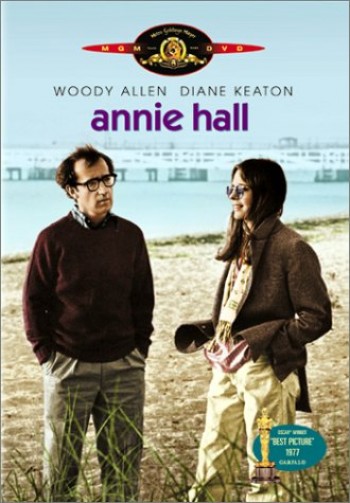
Annie Hall


'Annie Hall"contains more intellectual wit and cultural references than any other movie ever to win the Oscar for best picture, and in winning the award in 1977 it edged out "Star Wars," an outcome unthinkable today. The victory marked the beginning of Woody Allen's career as an important filmmaker (his earlier work was funny but slight) and it signaled the end of the 1970s golden age of American movies. With "Star Wars," the age of the blockbuster was upon us, and movies this quirky and idiosyncratic would find themselves shouldered aside by Hollywood's greed for mega-hits. "Annie Hall" grossed about $40 million--less than any other modern best picture winner, and less than the budgets of many of them.

Watching it again, 25 years after its April 1977 premiere, I am astonished by how scene after scene has an instant familiarity. Some of its lines have seeped into the general consciousness; they're known by countless people who never saw the movie, like Jack Nicholson's chicken salad speech from "Five Easy Pieces." For years I've invariably described spiders as being "as big as a Buick," and this movie may be where most people first heard Groucho Marx's comment that he would not want to belong to any club that would have him as a member.

Alvy Singer, the gag writer and stand-up comic played by Allen in the movie, is the template for many of his other roles--neurotic, wisecracking, kvetching, a romantic who is not insecure about sex so much as dubious about all the trouble it takes. Annie Hall, played by Diane Keaton, sets the form for many of Allen's onscreen girlfriends: Pretty, smart, scatterbrained, younger, with affection gradually fading into exasperation. Women put up with a lot in Allen's movies, but at a certain point they draw the line.


Alvy Singer, like so many other Allen characters and Allen himself, accompanies every experience in life with a running commentary. He lives in order to talk about living. And his interior monologues provide not merely the analysis but the alternative. After making love with Annie for the first time, Alvy rolls over, exhausted and depleted, and observes, "As Balzac said, 'There goes another novel'."

Alvy is smarter than the ground rules of Hollywood currently allow. Watching even the more creative recent movies, one becomes aware of a subtle censorship being imposed, in which the characters cannot talk about anything the audience might not be familiar with. This generates characters driven by plot and emotion rather than by ideas; they use catch-phrases rather than witticisms. Consider the famous sequence where Annie and Alvy are standing in line for the movies and the blowhard behind them pontificates loudly about Fellini. When the pest switches over to McLuhan, Alvy loses patience, confronts him, and then triumphantly produces Marshall McLuhan himself from behind a movie poster to inform him, "You know nothing of my work!" This scene would be penciled out today on the presumption that no one in the audience would have heard of Fellini or McLuhan.

"Annie Hall" is built on such dialogue, and centers on conversation and monologue. Because it is just about everyone's favorite Woody Allen movie, because it won the Oscar, because it is a romantic comedy, few viewers probably notice how much of it consists of people talking, simply talking. They walk and talk, sit and talk, go to shrinks, go to lunch, make love and talk, talk to the camera, or launch into inspired monologues like Annie's free-association as she describes her family to Alvy. This speech by Diane Keaton is as close to perfect as such a speech can likely be, climaxing with the memory of her narcoleptic Uncle George falling asleep and dying while waiting in line for a free turkey. It is all done in one take of brilliant brinksmanship, with Keaton (or Annie) right on the edge of losing it.

Because "Annie Hall" moves so quickly, is so fresh and alive, we may not notice how long some of Allen's takes are. He famously likes to shoot most scenes in master shots with all of the actors onscreen all of the time, instead of cutting on every line of dialogue. The critic David Bordwell has an illuminating article in the Spring 2002 issue of Film Quarterly that points out that Allen's average shot length (ASL) ranges high: 22 seconds for "Manhattan" and 35.5 seconds for "Mighty Aphrodite." Bordwell tells me "Annie Hall" has an ASL of 14.5 seconds (he says other 1977 films he clocked had an ASL of from 4 to 7 seconds). By comparison, the recent film "Armageddon" has an ASL of 2.3 seconds, a velocity that arguably makes intelligent dialogue impossible.

Alvy and Annie take a sly delight in their conversational skill; they're attracted to each other not by pheromones but by pacing. In the first conversation they have, after meeting as tennis partners, they fall naturally into verbal tennis:

Alvy: You want a lift?

Annie: Oh, why? Uh, you got a car?

Alvy: No, I was going to take a cab.

Annie: Oh, no. I have a car.

Alvy: You have a car? I don't understand. If you have a car, so then why did you say, 'Do you have a car?' like you wanted a lift?

Annie: I don't, I don't, geez, I don't know. I wasn't. ...I got this VW out there. (To herself) 'What a jerk, yeah. Would you like a lift?'

Alvy: Sure. Which way you goin'?

Annie: Me? Oh, downtown.

Alvy: Down ... I'm going uptown.

Annie: Oh well, you know I'm going uptown too.

Alvy: You just said you were going downtown.

Annie: Yeah, well, but I could ...

This is not merely dialogue, it is a double act in the process of discovering itself. The more we listen to Annie and Alvy talk, the more we doubt they meet many people who can keep up with them When Alvy expresses reluctance to let Annie move in with him, and she complains that her apartment is too small and has bad plumbing and bugs, who but Alvy could take "bugs" as his cue, and observe, "Entomology is a rapidly growing field." And only Annie could interpret this as, "You don't want me to live with you."

Alvy: I don't want you to live with me!? Whose idea was it?

Annie: Mine.

Alvy: Yeah, it was yours, actually, but I approved it immediately.

There are of course other women in Alvy's life, including the Rolling Stone correspondent (Shelley Duvall) who is a Rosicrucian (Alvy: "I can't get with any religion that advertises in Popular Mechanics"). And the liberal Democrat (Carol Kane) who Alvy marries but later splits up with because of their disagreements about the second gun theory of the Kennedy assassination. That Annie Hall is the great love of his life is immediately clear, and the movie is a flashback from the opening monologue in which he sadly notes that a year earlier they were in love; the movie is his analysis of what went wrong, and his answer is, he found happiness, but couldn't accept it. Groucho's line "is the key joke of my adult life, in terms of my relationships with women."

Lore about "Annie Hall" on imdb.com includes the revealing detail that Diane Keaton, who lived with Allen at the time, was born as Diane Hall, and her nickname was Annie. The movie originally contained a murder subplot, entirely dropped; a 140 minute rough cut became a 95 minute film in a process described in editor Ron Rosenblum's book When the Shooting Stops.

Viewing the final cut, I sensed not only how well the remains hold together but how miraculously, since the parts would seem to be an ungainly fit. Consider Allen's astonishing range of visual tactics, including split screens in which the characters on either side directly address one another; a bedroom scene where Annie's spirit gets up during sex to sit, bored, in a chair by the bed; autobiographical flashbacks; subtitles that reveal what characters are really thinking; children who address us as if they were adults ("I'm into leather"); an animated sequence pairing Alvy with Snow White's wicked witch; and the way Alvy speaks directly out of the screen to the audience.

This is a movie that establishes its tone by constantly switching between tones: The switches reflect the restless mind of the filmmaker, turning away from the apparent subject of a scene to find the angle that reveals the joke. "Annie Hall" is a movie about a man who is always looking for the loopholes in perfection. Who can turn everything into a joke, and wishes he couldn't.

Tuesday, August 4, 2009

Just Tell Me What You Want

“Just Tell Me What You Want” occupies a world most of us have fantasies about, the world of an incredibly powerful, self-made business tycoon. It’s a world that’s not new in the movies, but not often is it seen as sharply as in this film, which, amazingly, leaves us feeling fairly affectionate about the people involved: This is a film that could have just been high-class, soft-core trash, but it sneaks in a couple of fascinating characters and makes them real.

They are Max Herschel (Alan King), investor, art collector, husband, lover, overgrown baby, and Bones Burton (Ali MacGraw), his mistress, who’s in television production. She’s also his prize creation; they met, we gather, 13 years ago when she was a teenager, and Max has educated her, stage-managed her career, doted on her ever since.

But now there’s a crisis: Max has purchased a near-bankrupt studio, and wants to plunder it for its film library and then sell the real estate to make a sports stadium. But Bones wants to try to turn the studio around.

He can’t quite see his protégé succeeding on her own. But they have other problems, too. Bones, who has just had another abortion and isn’t getting any younger, wants to get married. But Max is still married, and supports his deranged wife (Dina Merrill) in a series of expensive private institutions. He also cheats on both his wife and his mistress.

Bones grows rebellious, falls in love with a young playwright, and marries him one morning. Max, enraged, tries to strip her of everything he’s ever given her. Bones, livid, violently attacks Max with her handbag in Bergdoff Goodman’s, in one of the movie’s funniest scenes. And Max, wounded, goes undercover to try to destroy Bones’s husband.

All of the ins and outs of the plot (and they are many) are essentially just props for the director, Sidney Lumet, who is mostly concerned with the characters of Max and Bones. The movie’s especially successful with Max, who comes across as virile, childish, bright, vindictive and perversely likable.

The performance by King is surprisingly good, considering how little feature film acting experience King has; King really inhabits the role of the rich tyrant, instead of just strutting through the dialogue. MacGraw is good, too, as Bones, making the character sexy primarily because of her intelligence.

The movie has several good supporting performances, especially by Myrna Loy, as an executive secretary who sees right through all of Max’s many moods, and by Keenan Wynn, as an ancient real estate tycoon who is Max’s chief competition. The whole cast, indeed, is plausible as real people, and that’s what makes this movie somewhat unusual.

There’s a whole genre of movies about the sex lives of the rich and famous, and the actors in them usually seem a little smaller than the lives they’re playing. Not this time: “Just Tell Me What You Want” somehow succeeds in taking on a tacky genre, overcoming it, and giving us a couple of actually interesting characters.