
Wednesday, August 5, 2009

Gone With The Wind


"Gone With the Wind'' presents a sentimental view of the Civil War, in which the ``Old South'' takes the place of Camelot and the war was fought not so much to defeat the Confederacy and free the slaves as to give Miss Scarlett O'Hara her comeuppance. But we've known that for years; the tainted nostalgia comes with the territory. Yet as ``GWTW'' approaches its 60th anniversary, it is still a towering landmark of film, quite simply because it tells a good story, and tells it wonderfully well.

For the story it wanted to tell, it was the right film at the right time. Scarlett O'Hara is not a creature of the 1860s but of the 1930s: a free-spirited, willful modern woman. The way was prepared for her by the flappers of Fitzgerald's jazz age, by the bold movie actresses of the period, and by the economic reality of the Depression, which for the first time put lots of women to work outside their homes.

Scarlett's lusts and headstrong passions have little to do with myths of delicate Southern flowers, and everything to do with the sex symbols of the movies that shaped her creator, Margaret Mitchell: actresses such as Clara Bow, Jean Harlow, Louise Brooks and Mae West. She was a woman who wanted to control her own sexual adventures, and that is the key element in her appeal. She also sought to control her economic destiny in the years after the South collapsed, first by planting cotton and later by running a successful lumber business. She was the symbol the nation needed as it headed into World War II; the spiritual sister of Rosie the Riveter.

Of course, she could not quite be allowed to get away with marrying three times, coveting sweet Melanie's husband Ashley, shooting a plundering Yankee, and banning her third husband from the marital bed in order to protect her petite waistline from the toll of childbearing. It fascinated audiences (it fascinates us still) to see her high-wire defiance in a male chauvinist world, but eventually such behavior had to be punished, and that is what ``Frankly, my dear, I don't give a damn'' is all about. If ``GWTW'' had ended with Scarlett's unquestioned triumph, it might not have been nearly as successful. Its original audiences (women, I suspect, even more than men) wanted to see her swatted down--even though, of course, tomorrow would be another day.

Rhett Butler was just the man to do it. As he tells Scarlett in a key early scene, ``You need kissing badly. That's what's wrong with you. You should be kissed, and often, and by someone who knows how.'' For ``kissed,'' substitute the word you're thinking of. Dialogue like that reaches something deep and fundamental in most people; it stirs their fantasies about being brought to sexual pleasure despite themselves. (``Know why women love the horse whisperer?'' I was asked by a woman friend not long ago. ``They figure, if that's what he can do with a horse, think what he could do with me.'') Scarlett's confusion is between her sentimental fixation on a tepid ``Southern gentleman'' (Ashley Wilkes) and her unladylike lust for a bold man (Rhett Butler). The most thrilling struggle in ``GWTW'' is not between North and South, but between Scarlett's lust and her vanity.

Clark Gable and Vivien Leigh were well matched in the two most coveted movie roles of the era. Both were well-served by a studio system that pumped out idealized profiles and biographies, but we now know what outlaws they were: Gable, the hard-drinking playboy whose studio covered up his scandals; Leigh, the neurotic, drug-abusing beauty who was the despair of every man who loved her.

They brought experience, well-formed tastes and strong egos to their roles, and the camera, which cannot lie and often shows more than the story intends, caught the flash of an eye and the readiness of body language that suggested sexual challenge. Consider the early scene where they first lay eyes on one another during the barbecue at Twelve Oaks. Rhett ``exchanges a cool, challenging stare with Scarlett,'' observes the critic Tim Dirks. ``She notices him undressing her with his eyes: `He looks as if--as if he knows what I look like without my shimmy.' ''

If the central drama of ``Gone With the Wind'' is the rise and fall of a sexual adventuress, the counterpoint is a slanted but passionate view of the Old South. Unlike most historical epics, ``GWTW'' has a genuine sweep, a convincing feel for the passage of time. It shows the South before, during and after the war, all seen through Scarlett's eyes. And Scarlett is a Southerner. So was Margaret Mitchell. The movie signals its values in the printed narration that opens the film, in language that seems astonishing in its bland, unquestioned assumptions:

``There was a land of Cavaliers and Cotton Fields called the Old South. Here in this pretty world, Gallantry took its last bow. Here was the last ever to be seen of Knights and their Ladies Fair, of Master and of Slave. Look for it only in books, for it is no more than a dream remembered, a Civilization gone with the wind.''

Yes, with the capital letters and all. One does not have to ask if the Slaves saw it the same way. The movie sidesteps the inconvenient fact that plantation gentility was purchased with the sweat of slaves (there is more sympathy for Scarlett getting calluses on her pretty little hands than for all the crimes of slavery). But to its major African-American characters it does at least grant humanity and complexity. Hattie McDaniel, as Mammy, is the most sensible and clear-sighted person in the entire story (she won one of the film's eight Oscars), and although Butterfly McQueen, as Prissy, will always be associated with the line ``I don't know nothin' about birthin' babies,'' the character as a whole is engaging and subtly subversive.

Remember that when ``GWTW'' was made, segregation was still the law in the South and the reality in the North. That the Ku Klux Klan was written out of one scene for fear of giving offense to elected officials who belonged to it. The movie comes from a world with values and assumptions fundamentally different from our own--and yet, of course, so does all great classic fiction, starting with Homer and Shakespeare. A politically correct ``GWTW'' would not be worth making, and might largely be a lie.

As an example of filmmaking craft, ``GWTW'' is still astonishing. Several directors worked on the film; George Cukor incurred Clark Gable's dislike and was replaced by Victor Fleming, who collapsed from nervous exhaustion and was relieved by Sam Wood and Cameron Menzies. The real auteur was the producer, David O. Selznick, the Steven Spielberg of his day, who understood that the key to mass appeal was the linking of melodrama with state-of-the-art production values. Some of the individual shots in ``GWTW'' still have the power to leave us breathless, including the burning of Atlanta, the flight to Tara and the ``street of dying men'' shot, as Scarlett wanders into the street and the camera pulls back until the whole Confederacy seems to lie broken and bleeding as far as the eye can see.

And there is a joyous flamboyance in the visual style that is appealing in these days when so many directors have trained on the blandness of television. Consider an early shot where Scarlett and her father look out over the land, and the camera pulls back, the two figures and a tree held in black silhouette with the landscape behind them. Or the way the flames of Atlanta are framed to backdrop Scarlett's flight in the carriage.

I've seen ``Gone With the Wind'' in four of its major theatrical revivals--1954, 1961, 1967 (the abortive ``widescreen'' version) and 1989, and now here is the 1998 restoration. It will be around for years to come, a superb example of Hollywood's art and a time capsule of weathering sentimentality for a Civilization gone with the wind, all right--gone, but not forgotten.

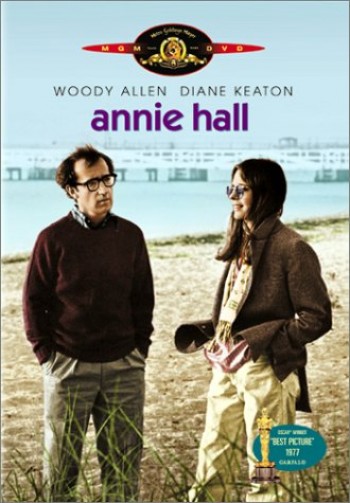
Annie Hall


'Annie Hall"contains more intellectual wit and cultural references than any other movie ever to win the Oscar for best picture, and in winning the award in 1977 it edged out "Star Wars," an outcome unthinkable today. The victory marked the beginning of Woody Allen's career as an important filmmaker (his earlier work was funny but slight) and it signaled the end of the 1970s golden age of American movies. With "Star Wars," the age of the blockbuster was upon us, and movies this quirky and idiosyncratic would find themselves shouldered aside by Hollywood's greed for mega-hits. "Annie Hall" grossed about $40 million--less than any other modern best picture winner, and less than the budgets of many of them.

Watching it again, 25 years after its April 1977 premiere, I am astonished by how scene after scene has an instant familiarity. Some of its lines have seeped into the general consciousness; they're known by countless people who never saw the movie, like Jack Nicholson's chicken salad speech from "Five Easy Pieces." For years I've invariably described spiders as being "as big as a Buick," and this movie may be where most people first heard Groucho Marx's comment that he would not want to belong to any club that would have him as a member.

Alvy Singer, the gag writer and stand-up comic played by Allen in the movie, is the template for many of his other roles--neurotic, wisecracking, kvetching, a romantic who is not insecure about sex so much as dubious about all the trouble it takes. Annie Hall, played by Diane Keaton, sets the form for many of Allen's onscreen girlfriends: Pretty, smart, scatterbrained, younger, with affection gradually fading into exasperation. Women put up with a lot in Allen's movies, but at a certain point they draw the line.


Alvy Singer, like so many other Allen characters and Allen himself, accompanies every experience in life with a running commentary. He lives in order to talk about living. And his interior monologues provide not merely the analysis but the alternative. After making love with Annie for the first time, Alvy rolls over, exhausted and depleted, and observes, "As Balzac said, 'There goes another novel'."

Alvy is smarter than the ground rules of Hollywood currently allow. Watching even the more creative recent movies, one becomes aware of a subtle censorship being imposed, in which the characters cannot talk about anything the audience might not be familiar with. This generates characters driven by plot and emotion rather than by ideas; they use catch-phrases rather than witticisms. Consider the famous sequence where Annie and Alvy are standing in line for the movies and the blowhard behind them pontificates loudly about Fellini. When the pest switches over to McLuhan, Alvy loses patience, confronts him, and then triumphantly produces Marshall McLuhan himself from behind a movie poster to inform him, "You know nothing of my work!" This scene would be penciled out today on the presumption that no one in the audience would have heard of Fellini or McLuhan.

"Annie Hall" is built on such dialogue, and centers on conversation and monologue. Because it is just about everyone's favorite Woody Allen movie, because it won the Oscar, because it is a romantic comedy, few viewers probably notice how much of it consists of people talking, simply talking. They walk and talk, sit and talk, go to shrinks, go to lunch, make love and talk, talk to the camera, or launch into inspired monologues like Annie's free-association as she describes her family to Alvy. This speech by Diane Keaton is as close to perfect as such a speech can likely be, climaxing with the memory of her narcoleptic Uncle George falling asleep and dying while waiting in line for a free turkey. It is all done in one take of brilliant brinksmanship, with Keaton (or Annie) right on the edge of losing it.

Because "Annie Hall" moves so quickly, is so fresh and alive, we may not notice how long some of Allen's takes are. He famously likes to shoot most scenes in master shots with all of the actors onscreen all of the time, instead of cutting on every line of dialogue. The critic David Bordwell has an illuminating article in the Spring 2002 issue of Film Quarterly that points out that Allen's average shot length (ASL) ranges high: 22 seconds for "Manhattan" and 35.5 seconds for "Mighty Aphrodite." Bordwell tells me "Annie Hall" has an ASL of 14.5 seconds (he says other 1977 films he clocked had an ASL of from 4 to 7 seconds). By comparison, the recent film "Armageddon" has an ASL of 2.3 seconds, a velocity that arguably makes intelligent dialogue impossible.

Alvy and Annie take a sly delight in their conversational skill; they're attracted to each other not by pheromones but by pacing. In the first conversation they have, after meeting as tennis partners, they fall naturally into verbal tennis:

Alvy: You want a lift?

Annie: Oh, why? Uh, you got a car?

Alvy: No, I was going to take a cab.

Annie: Oh, no. I have a car.

Alvy: You have a car? I don't understand. If you have a car, so then why did you say, 'Do you have a car?' like you wanted a lift?

Annie: I don't, I don't, geez, I don't know. I wasn't. ...I got this VW out there. (To herself) 'What a jerk, yeah. Would you like a lift?'

Alvy: Sure. Which way you goin'?

Annie: Me? Oh, downtown.

Alvy: Down ... I'm going uptown.

Annie: Oh well, you know I'm going uptown too.

Alvy: You just said you were going downtown.

Annie: Yeah, well, but I could ...

This is not merely dialogue, it is a double act in the process of discovering itself. The more we listen to Annie and Alvy talk, the more we doubt they meet many people who can keep up with them When Alvy expresses reluctance to let Annie move in with him, and she complains that her apartment is too small and has bad plumbing and bugs, who but Alvy could take "bugs" as his cue, and observe, "Entomology is a rapidly growing field." And only Annie could interpret this as, "You don't want me to live with you."

Alvy: I don't want you to live with me!? Whose idea was it?

Annie: Mine.

Alvy: Yeah, it was yours, actually, but I approved it immediately.

There are of course other women in Alvy's life, including the Rolling Stone correspondent (Shelley Duvall) who is a Rosicrucian (Alvy: "I can't get with any religion that advertises in Popular Mechanics"). And the liberal Democrat (Carol Kane) who Alvy marries but later splits up with because of their disagreements about the second gun theory of the Kennedy assassination. That Annie Hall is the great love of his life is immediately clear, and the movie is a flashback from the opening monologue in which he sadly notes that a year earlier they were in love; the movie is his analysis of what went wrong, and his answer is, he found happiness, but couldn't accept it. Groucho's line "is the key joke of my adult life, in terms of my relationships with women."

Lore about "Annie Hall" on imdb.com includes the revealing detail that Diane Keaton, who lived with Allen at the time, was born as Diane Hall, and her nickname was Annie. The movie originally contained a murder subplot, entirely dropped; a 140 minute rough cut became a 95 minute film in a process described in editor Ron Rosenblum's book When the Shooting Stops.

Viewing the final cut, I sensed not only how well the remains hold together but how miraculously, since the parts would seem to be an ungainly fit. Consider Allen's astonishing range of visual tactics, including split screens in which the characters on either side directly address one another; a bedroom scene where Annie's spirit gets up during sex to sit, bored, in a chair by the bed; autobiographical flashbacks; subtitles that reveal what characters are really thinking; children who address us as if they were adults ("I'm into leather"); an animated sequence pairing Alvy with Snow White's wicked witch; and the way Alvy speaks directly out of the screen to the audience.

This is a movie that establishes its tone by constantly switching between tones: The switches reflect the restless mind of the filmmaker, turning away from the apparent subject of a scene to find the angle that reveals the joke. "Annie Hall" is a movie about a man who is always looking for the loopholes in perfection. Who can turn everything into a joke, and wishes he couldn't.

Tuesday, August 4, 2009

John Tucker Must Die


This is your embedded middle-aged male movie critic, reporting from somewhere near the unprotected border between pubescent girlhood and young womanhood. The breaking story: a teen comedy called "John Tucker Must Die."

Sometimes a movie critic just has to acknowledge that he does not fall within a particular film's target demographic. But it can be a fascinating and enlightening sociological expedition to see it with the very audience for whom it was intended. In this instance, that meant watching "John Tucker Must Die" from deep inside a preview screening of about 78 percent teenage girls, 21 percent teenage boys, and 0.4 percent movie critics. I do not know who those other 0.6 percent were, or what they were doing there.

The crowd didn't clap at the end or anything, but they laughed, and sighed a few times, and talked and text messaged each other unceasingly throughout, despite being warned by burly uniformed security dudes upon entering the auditorium that all cell phones were to be turned off before entering. Yeah, right. There were so many little screens flickering all over the theater that it looked like the projector beam was hitting a disco ball.

This is the way a significant minority of viewers will encounter "John Tucker Must Die," because we can already be pretty sure most of them will see it on DVD in an environment where their voice and text conversations will not be hindered by semi-darkness or adults who turn around and tell them to shut the hell up.

Not as mean as "Mean Girls," as raunchy as "American Pie," or as sappy as, say, the Shirley Temple version of "Heidi" (and I have seen them all), "John Tucker Must Die" isn't half bad. It's about two-fifths bad, mostly toward the incoherent ending, but that ratio is... well, not bad.

The title character is the most popular boy in school, John Tucker (Jesse Metcalfe, Eva Longoria's boy-toy gardener on "Desperate Housewives"). He's gorgeous, in a Ken doll with eyebrows kind of way, a star athlete, the captain of the basketball team, and he's triple-timing three of the hottest girls in school, none of whom knows he's also dating the others. In other words, he's a typical teenage male sociopath, a slick, winning Ted Bundy who has not yet graduated to full-fledged serial killing.

But when the girls find out he's been cheating on them -- all of them -- they unite to wreak their revenge. There's Carrie (Arielle Kebbel), the blonde white girl who reports for the school TV station; Heather (Ashanti), the henna-haired black girl who's the head cheerleader in every sense of the word; and Beth (Sophia Bush), the brunette white girl who describes herself alternately as a teen vegan activist and a slut. (The language doesn't get any harsher than that -- this is PG-13.) Oh, and if the names "Carrie" and "Heather" don't mean anything to you, you might want to brush up on your high school girl movies.

Bringing them all together is Kate (Brittany Snow), the ugly duckling and socially "invisible" girl who, as is invariably the case in these movies, is so much prettier than the "pretty" popular girls that it's not even funny. In any high school in America, Kate's looks alone would make her Miss Popularity before you could say "First Period Algebra." But this is the movies. Kate's hot mom Lori (Jenny McCarthy) wears a Black Sabbath t-shirt and keeps entering into short-lived affairs with interchangeable jerks Kate has taken to calling by a single name: Skip. Because that's what they always do.

Kate has a negative view of heterosexual relationships, having never actually witnessed a functional one. She is taken in, and made over, by the other girls as part of a series of plots to humiliate and devastate John Tucker in front of the whole school. Meanwhile, Kate becomes lab partners with "The Other Tucker," John's "invisible" brother Scott (Penn Badgley, borrowing Heath Ledger's old hair for the role), with whom she feels a certain kinship. Possibly a kissing kinship. By the end of the movie he's wearing a t-shirt with the word "INTEGRITY" on it, in case you're left with any doubt that he's more her type than his brother John, who will surely grow up to head an overvalued off-shore corporation and eventually be indicted for fraud.

"John Tucker Must Die" is kind of "Carrie" in reverse. While Kate is tarted up to provide suitable nookie-bait for John Tucker, and must invoke iron will to resist his hunky, psycho-skeezy wiles, he is the one who will get the (figurative) bucket of pig's blood dumped on his head in the climactic party scene. That's also the part where, unfortunately, everything rapidly degenerates into a messy free-for-all -- and that's a description of what happens to the movie, not just what happens in it.

Still, for the most part director Betty Thomas, the Second City alumnus, former "Hill Street Blues" cast member and helmer of Howard Stern's "Private Parts" and "The Brady Bunch Movie," gets more out of this material, and her cast, than we had any reason to anticipate. The performances are loose, relaxed and -- dare I say it? -- almost improvisational. What was the last teen comedy in which any lines were underplayed or tossed off casually, instead of the actors practically yelling them into the camera so as to be heard over the banks of mobile phones in the audience? (That's a rhetorical question, please.)

This is Metcalfe's first starring role in a motion picture, and while Snow is the real star here, he displays a sense of humor about himself that's beyond anything required of him on "Desperate Housewives," which is tipped more toward soap opera acting than comedy -- with the fine exception of Felicity Huffman. The scene where he has a meltdown at a basketball game, brought on by slipping him estrogen pills, is played just right -- broad, but not smack-us-in-the-face-with-a-halibut broad.

My favorite moment was also the one in which my movie-critic cover was inadvertently blown. Scott tries to tell his BMOC brother that he probably isn't Kate's kind of guy. "She likes old school Elvis Costello, listens to obscure podcasts, and she reads Dave Eggers," he says. "She's deep." Baritone laughter erupted from... two adult males in the crowd. Other than that, stone silence. But that's a funny line. And I'm happy to say, from the way it's delivered, you can bet Betty Thomas knows it's funny, too.

Just Tell Me What You Want

“Just Tell Me What You Want” occupies a world most of us have fantasies about, the world of an incredibly powerful, self-made business tycoon. It’s a world that’s not new in the movies, but not often is it seen as sharply as in this film, which, amazingly, leaves us feeling fairly affectionate about the people involved: This is a film that could have just been high-class, soft-core trash, but it sneaks in a couple of fascinating characters and makes them real.

They are Max Herschel (Alan King), investor, art collector, husband, lover, overgrown baby, and Bones Burton (Ali MacGraw), his mistress, who’s in television production. She’s also his prize creation; they met, we gather, 13 years ago when she was a teenager, and Max has educated her, stage-managed her career, doted on her ever since.

But now there’s a crisis: Max has purchased a near-bankrupt studio, and wants to plunder it for its film library and then sell the real estate to make a sports stadium. But Bones wants to try to turn the studio around.

He can’t quite see his protégé succeeding on her own. But they have other problems, too. Bones, who has just had another abortion and isn’t getting any younger, wants to get married. But Max is still married, and supports his deranged wife (Dina Merrill) in a series of expensive private institutions. He also cheats on both his wife and his mistress.

Bones grows rebellious, falls in love with a young playwright, and marries him one morning. Max, enraged, tries to strip her of everything he’s ever given her. Bones, livid, violently attacks Max with her handbag in Bergdoff Goodman’s, in one of the movie’s funniest scenes. And Max, wounded, goes undercover to try to destroy Bones’s husband.

All of the ins and outs of the plot (and they are many) are essentially just props for the director, Sidney Lumet, who is mostly concerned with the characters of Max and Bones. The movie’s especially successful with Max, who comes across as virile, childish, bright, vindictive and perversely likable.

The performance by King is surprisingly good, considering how little feature film acting experience King has; King really inhabits the role of the rich tyrant, instead of just strutting through the dialogue. MacGraw is good, too, as Bones, making the character sexy primarily because of her intelligence.

The movie has several good supporting performances, especially by Myrna Loy, as an executive secretary who sees right through all of Max’s many moods, and by Keenan Wynn, as an ancient real estate tycoon who is Max’s chief competition. The whole cast, indeed, is plausible as real people, and that’s what makes this movie somewhat unusual.

There’s a whole genre of movies about the sex lives of the rich and famous, and the actors in them usually seem a little smaller than the lives they’re playing. Not this time: “Just Tell Me What You Want” somehow succeeds in taking on a tacky genre, overcoming it, and giving us a couple of actually interesting characters.

Toy Story


"Toy Story" creates a universe out of a couple of kid's bedrooms, a gas station, and a stretch of suburban highway. Its heroes are toys, which come to life when nobody is watching. Its conflict is between an old-fashioned cowboy who has always been a little boy's favorite toy, and the new space ranger who may replace him. The villain is the mean kid next door who takes toys apart and puts them back together again in macabre combinations. And the result is an visionary roller-coaster ride of a movie.

For the kids in the audience, a movie like this will work because it tells a fun story, contains a lot of humor, and is exciting to watch. Older viewers may be even more absorbed, because "Toy Story," the first feature made entirely by computer, achieves a three-dimensional reality and freedom of movement that is liberating and new. The more you know about how the movie was made, the more you respect it.

Imagine the spectacular animation of the ballroom sequence in "Beauty and the Beast" at feature length and you'll get the idea. The movie doesn't simply animate characters in front of painted backdrops; it fully animates the characters and the space they occupy, and allows its point of view to move freely around them. Computer animation has grown so skillful that sometimes you don't even notice it (the launching in "Apollo 13" took place largely within a computer). Here, you do notice it, because you're careening through space with a new sense of freedom.

Consider for example a scene where Buzz Lightyear, the new space toy, jumps off a bed, bounces off a ball, careens off of the ceiling, spins around on a hanging toy helicopter and zooms into a series of loop-the-loops on a model car race track. Watch Buzz, the background, and the perspective -- which stretches and contracts to manipulate the sense of speed. It's an amazing ride.

I learn from the current Wired magazine that the movie occupied the attention of a bank of 300 powerful Sun microprocessors, the fastest models around, which took about 800,000 hours of computing time to achieve this and other scenes -- at 2 to 15 hours per frame. Each frame required as much as 300 MBs of information, which means that on my one-gigabyte hard disk, I have room for about three frames, or an eighth of a second. Of course computers are as dumb as a box of bricks if they're not well-programmed, and director John Lasseter, a pioneer in computer animation, has used offbeat imagination and high energy to program his.

But enough of this propeller-head stuff. Let's talk about the movie. Lasseter and his team open the film in a kid's bedroom, where the toys come to life when their owner is absent. Undisputed king of the toys is Woody, a cowboy with a voice by Tom Hanks. His friends include Mr. Potato Head (Don Rickles), Slinky Dog (Jim Varney), Hamm the Pig (John Ratzenberger) and Bo Peep (Annie Potts). The playroom ingeniously features famous toys from real life toys (which may be product placement, but who cares), including a spelling slate that does a running commentary on key developments (when Mr. Potato Head finally achieves his dream of Mrs. Potato Head, the message is "Hubba! Hubba!).

One day there's a big shakeup in this little world. The toy owner, named Andy, has a birthday. Woody dispatches all of the troops in a Bucket of Soldiers to spy on developments downstairs, and they use a Playskool walkie-talkie to broadcast developments. The most alarming: The arrival on the scene of Buzz Lightyear (Tim Allen), a space ranger.

Buzz is the most endearing toy in the movie, because he's not in on the joke. He thinks he's a real space ranger, temporarily marooned during a crucial mission, and he goes desperately to work trying to repair his space ship -- the cardboard box he came in. There's real poignancy later in the film when he sees a TV commercial for himself, and realizes he's only a toy.

The plot heats up when the human family decides to move, and Woody and Buzz find themselves marooned in a gas station with no idea how to get home. (It puts a whole new spin on the situation when a toy itself says, "I'm a lost toy!") And later there's a terrifying interlude in the bedroom of Sid, the dreadful boy next door, who takes his toys apart and reassembles them like creatures from a nightmare. (His long suffering sister is forced to hold a tea party for headless dolls.)

Seeing "Toy Story," I felt some of the same exhilaration I felt during "Who Framed Roger Rabbit." Both movies take apart the universe of cinematic visuals, and put it back together again, allowing us to see in a new way. "Toy Story" is not as inventive in its plotting or as clever in its wit as "Rabbit" or such Disney animated films as "Beauty and the Beast"; it's pretty much a buddy movie transplanted to new terrain. Its best pleasures are for the eyes. But what pleasures they are! Watching the film, I felt I was in at the dawn of a new era of movie animation, which draws on the best of cartoons and reality, creating a world somewhere in between, where space not only bends but snaps, crackles and pops.

The Bank Job

A serviceable B-grade British heist movie, “The Bank Job” is no worse than its generic title. And no better. It front-loads the naughty sex and back-loads the plot twists (the titular crime takes place in the middle), but apart from the prominence of Princess Margaret in the subterfuge, it’s a pretty routine job, as the use of the hackneyed phrase “plot twists” earlier in this sentence should indicate.

“The Bank Job” begins with a quick time-shuffle of the sort to which modern audiences have become accustomed. It starts in 1970 in the Caribbean. Literally in it. Brief shots of sub-aquatic toplessness are followed by a quick-and-blurry tropical fornication montage and a little retro-voyeuristic shutterbugging. Next, it’s East London in 1971 and some hoods are making violent threats against a stubbly car shop dealer named Terry Leather (Jason Statham). Then it’s three weeks earlier and ...

You know the drill. At first you think Guy Ritchie might be rolling in his grave — only he’s not dead, just his career. That’s the kind of cheap shot you have plenty of time to think about as this movie grinds through its laboriously disjointed exposition.

It doesn’t stick to that approach for long, though. Once the picture gets its chronology sorted out (why did it employ flashbacks to begin with?), it eventually works up some downhill momentum near the end. But for a movie about royal scandals, spies, cops, villains (slang for crooks and thugs), prostitutes, pornographers, strip clubs, payoffs, radical-chic black-power celebrity gangsters, murder, torture, blackmail, double-crossings, extramarital temptations... you’d sure think “The Bank Job” would be more fun to watch. Instead, it seems a little distracted, continually glancing back over its shoulder at a few hundred other caper films and crime thrillers. Once it triggers memories of movies as diverse as "The Asphalt Jungle," “Rififi,” "Le Cercle Rouge," “The Italian Job,” “Reservoir Dogs,” “Ocean’s Eleven,” “Inside Man” — and how could it not? — you may realize that you’re not having quite as much fun watching this picture as you did watching those.

One semi-redeeming element is that the film was inspired by true events. The shocking 1971 Lloyds Bank robbery was a big story, until four days later when it suddenly wasn’t. The whole thing abruptly and mysteriously vanished from the papers, radio and television, reportedly due to a “D-Notice” issued by the highest authorities banning all press coverage.

But why? Did an opportunistic pseudo-radical black-power fascist who called himself Michael X really hide scandalous photographs of Princess Margaret in a London vault and then use the threat of exposure to blackmail the British government? Did Her Majesty’s Secret Service (“Spooks — MI5 or MI6, I can’t tell the difference,” a cop says) really engineer a bank robbery using small-time hoods to break into Pandora’s safety deposit box and retrieve the damning evidence before it escaped into the public domain?

Those are the premises of the script by Dick Clement and Ian La Frenais (“Across the Universe,” “Flushed Away”). But how much is truth and how much is inspiration? Nobody quite knows. A recent article about the infamous “Walkie-Talkie Bank Job” on the Web site of the British tabloid The Daily Mail (Feb. 16, 2008) reports:

“Speculation quickly arose that compromising sexual photographs of the queen’s sister, the late Princess Margaret, had been uncovered in the bank vault.

"It was rumoured they had been stashed away by well-known underworld figure Michael X. A drug dealer and Black Power leader, he was convicted of murder and hanged in Trinidad in 1975. A government file on him will remain closed until 2054. The Mirror can for the first time reveal that Fleet Street editors of the day were approached directly by senior government officials and told to drop the story.”

And it’s such a good story. What a shame it isn’t more memorably told. The director is the bewilderingly uneven Roger Donaldson (“Smash Palace,” “No Way Out,” “Cadillac Man,” “Cocktail”). The cast are fine (as British grammar would have it).

The Apartment


There is a melancholy gulf over the holidays between those who have someplace to go, and those who do not. ''The Apartment'' is so affecting partly because of that buried reason: It takes place on the shortest days of the year, when dusk falls swiftly and the streets are cold, when after the office party some people go home to their families and others go home to apartments where they haven't even bothered to put up a tree. On Christmas Eve, more than any other night of the year, the lonely person feels robbed of something that was there in childhood and isn't there anymore.

Jack Lemmon plays C.C. Baxter, a definitive lonely guy, in ''The Apartment,'' with the ironic twist that he is not even free to go home alone, because his apartment is usually loaned out to one of the executives at his company. He has become the landlord for a series of their illicit affairs; they string him along with hints about raises and promotions. His neighbor Dr. Dreyfuss (Jack Kruschen) hears the nightly sounds of passion through the wall and thinks Baxter is a tireless lover, when in fact Baxter is pacing the sidewalk out in front, looking up resentfully at his own lighted window.

When Billy Wilder made ''The Apartment'' in 1960, ''the organization man'' was still a current term. One of the opening shots in the movie shows Baxter as one of a vast horde of wage slaves, working in a room where the desks line up in parallel rows almost to the vanishing point. This shot is quoted from King Vidor's silent film ''The Crowd'' (1928), which is also about a faceless employee in a heartless corporation. Cubicles would have come as revolutionary progress in this world.

Baxter has no girlfriend and, apparently, no family. Patted on the back and called ''buddy boy'' by the executives who use him, he dreams of a better job and an office of his own. One day he even gets up his nerve and asks out one of the elevator girls, Miss Kubelik (Shirley MacLaine), but she stands him up at the last moment because of a crisis in her relationship with the big boss, Mr. Sheldrake (Fred MacMurray). She thought her affair with Sheldrake was over, but now apparently it's on again; he keeps talking about divorcing his wife, but never does.

The screenplay, executed as a precise balance between farce and sadness, has been constructed by Wilder and I.A.L. Diamond to demonstrate that while Baxter and Miss Kubelik may indeed like each other--may feel genuine feelings of the sort that lead to true love--they are both slaves to the company's value system. He wants to be the boss' assistant, she wants to be the boss' wife, and both of them are so blinded by the concept of ''boss'' that they can't see Mr. Sheldrake for an untrustworthy rat.

The movie has been photographed in widescreen black and white. The b&w dampens down any jollity that might sweep in with the decorations at the Christmas parties, bars and restaurants where the holidays are in full swing. And the widescreen emphasizes space that separates the characters, or surrounds them with emptiness. The design of Baxter's apartment makes his bedroom door, in the background just to the left of center, a focal point; in there reside the secrets of his masters, the reasons for his resentments, the arena for his own lonely slumber, and eventually the stage on which Miss Kubelik will play out the crucial transition in her life.

Other shots track down Manhattan streets and peer in through club windows, and isolate Miss Kubelik and the phony-sincere Mr. Sheldrake in their booth at the Chinese restaurant, where he makes earnest protestations of his good intentions, and glances uneasily at his watch.

By the time he made ''The Apartment,'' Wilder had become a master at a kind of sardonic, satiric comedy that had sadness at its center. ''Double Indemnity'' (1944) was about a man (MacMurray again) who trusted that one simple crime would solve his romantic and financial troubles. ''Sunset Boulevard'' has William Holden as a paramour to a grotesque aging movie queen (Gloria Swanson), but there was pathos in the way her former husband (Erich von Stroheim) still worshiped at the shrine of her faded greatness.

Wilder was fresh off the enormous hit ''Some Like it Hot'' (1959), his first collaboration with Lemmon, and Lemmon was headed toward ''The Days of Wine and Roses'' (1962), which along with ''The Apartment'' showed that he could move from light comedian to tragic everyman. This movie was the summation of what Wilder had done to date, and the key transition in Lemmon's career.

It was also a key film for Shirley MacLaine, who had been around for five years in light comedies and had good scenes in ''Some Came Running'' (1958) but here emerged as a serious actress who would flower in the 1960s.

What is particularly good about her Miss Kubelik is the way she doesn't make her a ditzy dame who falls for a smooth talker, but suggests a young woman who has been lied to before, who has a good heart but finite patience, who is prepared to make the necessary compromises to be the next Mrs. Sheldrake. The underlying seriousness of MacLaine's performance helps anchor the picture--it raises the stakes, and steers it away from any tendency to become musical beds.

What's particularly perceptive is the way, after her suicide attempt, she hauls herself together and actually gives Sheldrake another chance. Like Baxter, she has not been forced into job prostitution, but chosen it. One of the ways this is an adult picture and not a sitcom is the way it takes Baxter and Miss Kubelik so long to make the romantic leap; they aren't deluded fools, but jaded realists who have given up on love and are more motivated by paychecks. There is a wonderful, wicked, delicacy in the way Wilder handles the final scene, and finds the right tender-tough note in the last lines of the screenplay. (''Shut up and deal'' would become almost as famous as ''nobody's perfect,'' the immortal closing lines of ''Some Like it Hot.'')

As it happened, I watched ''The Apartment'' not long after Jack Lemmon's death, and looked at Blake Edwards' ''The Days of Wine and Roses'' (1962) and James Foley's ''Glengarry Glen Ross'' (1992) at the same time. The side-by-side viewings were an insight into Lemmon's acting, and into changing styles in movies. ''The Days of Wine and Roses'' has dated, in my opinion; the famous greenhouse scene looks more like overacting than alcoholism. Wilder's ''The Lost Weekend'' (1945) was made 17 years earlier but feels more contemporary in his treatment of alcoholism. ''Glengarry Glen Ross'' contains probably Lemmon's best performance. His aging, desperate real estate salesman is deserving of comparison with anyone's performance of Willy Loman in ''Death of a Salesman,'' and it is interesting how Lemmon, who famously began with directors asking him to dial down and give ''a little less,'' was able here to hit the precise tones needed for the David Mamet dialogue, which is realism cloaked in mannerism.

In observing that ''The Lost Weekend'' hasn't dated, I could be making a comment about Wilder's work in general. Even a lightweight romantic comedy like ''Sabrina'' (1954) holds up better than its 1990s remake, and the great Wilder pictures don't play as period pieces but look us straight in the eye. ''Some Like It Hot'' is still funny, ''Sunset Boulevard'' is still a masterful gothic character comedy, and ''The Apartment'' is still tougher and more poignant than the material might have permitted. The valuable element in Wilder is his adult sensibility; his characters can't take flight with formula plots, because they are weighted down with the trials and responsibilities of working for a living. In many movies, the characters hardly even seem to have jobs, but in ''The Apartment'' they have to be reminded that they have anything else.