Friday, August 7, 2009

Breathless


When we talked, I talked about me, you talked about you, when we should have talked about each other.
--Michel to Patricia

Modern movies begin here, with Jean-Luc Godard's "Breathless" in 1960. No debut film since "Citizen Kane" in 1942 has been as influential. It is dutifully repeated that Godard's technique of "jump cuts" is the great breakthrough, but startling as they were, they were actually an afterthought, and what is most revolutionary about the movie is its headlong pacing, its cool detachment, its dismissal of authority, and the way its narcissistic young heroes are obsessed with themselves and oblivious to the larger society.

There is a direct line through "Breathless" to "Bonnie and Clyde," "Badlands" and the youth upheaval of the late 1960s. The movie was a crucial influence during Hollywood's 1967-1974 golden age. You cannot even begin to count the characters played by Pacino, Beatty, Nicholson, Penn, who are directly descended from Jean-Paul Belmondo's insouciant killer Michel.

"Breathless" remains a living movie that retains the power to surprise and involve us after all these years. What fascinates above all is the naivete and amorality of these two young characters: Michel, a car thief who idolizes Bogart and pretends to be tougher than he is, and Patricia (Jean Seberg), an American who peddles the Paris edition of the New York Herald-Tribune while waiting to enroll at the Sorbonne. Do they know what they're doing? Both of the important killings in the movie occur because Michel accidentally comes into possession of someone else's gun; Patricia's involvement with him seems inspired in equal parts by affection, sex and fascination with his gangster persona.

Michel wants to be as tough as the stars in the movies he loves. He practices facial expressions in the mirror, wears a fedora, and is never, ever seen without a cigarette, removing one from his mouth only to insert another. So omnipresent is this cigarette that Godard is only kidding us a little when Michel's dying breath is smoky. But Belmondo at 26 still had a little of the adolescent in him, and the first time we see him, his hat and even his cigarette seem too big for his face. He was "hypnotically ugly," Bosley Crowther wrote in his agitated New York Times review, but that did not prevent him from becoming the biggest French star between Jean Gabin and Gerard Depardieu.

Seberg was restarting her career after its disastrous launch in America. Otto Preminger staged a famous talent search for the star of his "Saint Joan" (1957), and cast an inexperienced 18-year-old Marshalltown, Iowa, girl; Seberg received terrible reviews, not entirely deserved, and more bad notices for "Bonjour Tristesse" (1958), which Preminger made next to prove himself right. She fled to Europe, where she was only 21 when Godard cast her for "Breathless."

Her Patricia is the great enigma of the movie. Michel we can more or less read at sight: He postures as a gangster, maintains a cool facade, is frightened underneath. His persona is a performance that functions to conceal his desperation. But what about Patricia? Somehow it is never as important as it should be that she thinks she is pregnant, and that Michel is the father. She receives startling items of information about Michel (that he is a killer, that he is married, that he has more than one name) with such apparent detachment that we study that perfectly molded gamin face and wonder what she can possibly be thinking. Even her betrayal of him turns out to be not about Michel, and not about right and wrong, but only a test she sets for herself to determine if she loves him or not. It is remarkable that the reviews of this movie do not describe her as a monster--more evil, because she's less deluded, than Michel.

The filming of "Breathless" has gathered about it a body of legend. It was one of the key films of the French New Wave, which rejected the well-made traditional French cinema and embraced a rougher, more experimental personal style. Many of the New Wave directors began as critics for the anti-establishment magazine Cahiers du Cinema. The credits for "Breathless" are a New Wave roll call, including not only Godard's direction but an original story by Francois Truffaut (Godard famously wrote each day's shooting script in the morning). Claude Chabrol is production designer and technical adviser, the writer Pierre Boulanger plays the police inspector, and there are small roles for Truffaut and Godard himself (as the informer). Everyone was at the party; the assistant director was Pierre Rissient, who wears so many hats he is most simply described as knowing more people in the cinema than any other single person.

Jean-Pierre Melville, whose own crime movies in the 1950s pointed the way to the New Wave, plays the writer interviewed by Patricia at Orly, where he expounds on life and sex ("Two things are important in life. For men, women. For women, money"). Melville's "Bob Le Flambeur" (1955) is referenced when we meet the man who informed on Bob, or when Michel tells a friend, "Bob the gambler would have cashed my check."

One inside joke in the film is always mentioned, but is not really there. Michel's alias is "Laszlo Kovacs," and countless writers inform us this is a reference to the legendary Hungarian cinematographer. In fact, Godard had not met Kovacs at the time, and the reference is to the character Belmondo played in Chabrol's "A Double Tour" (1959). In a film with so many references to the past of the cinema, it is amusing to find a coincidental reference to its future.

Godard's key collaborator on the film was the cinematographer Raoul Coutard, who worked with him many times, notably on "Weekend" (1967). It was only Coutard's fourth film, and his methods became legend: How when they could not afford tracks for a tracking shot, he held the camera and had himself pushed in a wheelchair. How he achieved a grainy look that influenced many other fiction films that wanted to seem realistic. How he scorned fancy lighting. How he used hand-held techniques even before lightweight cameras were available. How he timed one shot of Belmondo so that the streetlights on the Champs Elysses came on behind him. There is a lovely backlit shot of Belmondo in bed and Seberg sitting beside the bed, both smoking, the light from the window enveloping them in a cloud.

That's from a long scene that's alive with freshness and spontaneity. Patricia returns home to find Michel in her bed, and they talk, flirt, smoke, fight, finally make love. She quotes Faulkner: "Between grief and nothing, I will take grief." Michel says he would choose nothing; "grief is a compromise." She poses in front of a Renoir poster of a young girl, and asks who is prettier. Michel sits below a Picasso poster of a man holding a mask. Throughout this long scene, perplexingly, they both throw their discarded cigarettes out the window.

In this scene and throughout the film, Godard uses jump cuts--cuts within continuous movement or dialogue, with no attempt made to make them match. The technique "was a little more accidental than political," writes the Australian critic Jonathan Dawson. The finished film was 30 minutes too long, and "rather than cut out whole scenes or sequences, Godard elected to trim within the scene, creating the jagged cutting style still so beloved of action filmmakers. Godard just went at the film with the scissors, cutting out anything he thought boring."

The technique adds charm to a scene where the two drive through Paris in a stolen convertible, and there is a series of closeup cuts over her shoulder as Michel describes her. When the two lovers, fleeing the police, sneak into a movie, it is a scene directly quoted in "Bonnie and Clyde"--which, we recall, both Godard and Truffaut were once to direct. In each case, the dialogue reflects the action; Bonnie and Clyde hear "we're in the money," and Michel and Patricia hear dialogue about a woman "covering up for a cheap parasite."

The movie had a sensational reception; it is safe to say the cinema was permanently changed. Young directors saw it and had abandoned their notions of the traditional studio film before they left the theater. Crowther of the Times, who was later to notoriously despise its descendant "Bonnie and Clyde," said of "Breathless" that "sordid is really a mild word for its pile-up of gross indecencies." The jump cuts to him were "pictorial cacophony."

Yet Crowther conceded, "It is no cliche," and the film's bold originality in style, characters and tone made a certain kind of genteel Hollywood movie quickly obsolete. Godard went on to become the most famous innovator of the 1960s, although he lost the way later, with increasingly mannered experiments. Here in one quick, sure move, knowing somehow just what he wanted and how to obtain it, he achieved a turning point in the cinema just as surely as Griffith did with "Birth of a Nation" and Welles with "Citizen Kane."

Beauty and the Beast

Before Disney's 1991 film and long before the Beast started signing autographs in Orlando, Jean Cocteau filmed "Beauty and the Beast" in 1946, in France. It is one of the most magical of all films. Before the days of computer effects and modern creature makeup, here is a fantasy alive with trick shots and astonishing effects, giving us a Beast who is lonely like a man and misunderstood like an animal. Cocteau, a poet and surrealist, was not making a "children's film" but was adapting a classic French tale that he felt had a special message after the suffering of World War II: Anyone who has an unhappy childhood may grow up to be a Beast.

Those familiar with the 1991 cartoon will recognize some of the elements of the story, but certainly not the tone. Cocteau uses haunting images and bold Freudian symbols to suggest that emotions are at a boil in the subconscious of his characters. Consider the extraordinary shot where Belle waits at the dining table in the castle for the Beast's first entrance. He appears behind her and approaches silently. She senses his presence, and begins to react in a way that some viewers have described as fright, although it is clearly orgasmic. Before she has even seen him, she is aroused to her very depths, and a few seconds later, as she tells him she cannot marry--a Beast!--she toys with a knife that is more than a knife.

The Beast's dwelling is one of the strangest ever put on film--Xanadu crossed with Dali. Its entrance hall is lined with candelabra held by living human arms that extend from the walls. The statues are alive, and their eyes follow the progress of the characters (are they captives of the Beast, imprisoned by spells?). The gates and doors open themselves. As Belle first enters the Beast's domain, she seems to run dreamily a few feet above the floor. Later, her feet do not move at all, but she glides, as if drawn by a magnetic force. (This effect has been borrowed by Spike Lee.) She is disturbed to see smoke rising from the Beast's fingertips--a sign that he has killed. When he carries her into her bed chamber, she has common clothes on one side of the door and a queen's costume on the other.

Belle has come to the castle as a hostage. She lives at home with her father, two unkind sisters and a silly brother, whose handsome friend wants to marry her. But she cannot marry, for she must care for Poppa. His business is threatened, and he learns on a trip to a seaport that he has lost everything. On his way home, through a forest on a stormy night, he happens upon the Beast's castle, and is taken prisoner and told he must die. The Beast offers a deal: He can go home if he will return in three days, or he can send one of his daughters. The other sisters of course sniff and make excuses, and their father says he is old and nearly dead and will return himself. But Belle slips out and rides the Beast's white horse, which knows the way to the castle. And the Beast's first words tell her, "You are in no danger."

Indeed she is not. The Beast has perhaps intuited that a daughter who would take her father's place has a good heart. He tells her that every night at 7 he will ask her the same question: "Will you be my wife?" She shudders and says she will never marry him, but eventually her heart softens, and she pities him and sees that he is good. He gives her a magical glove that allows her to travel instantly between the castle and her home (emerging whole from the wall), and there is intrigue involving the key to the garden where his fortune is held. The sisters plot and scheme, but Belle of course prevails. Her father rises up from his deathbed, the Beast sinks into a final illness instead, and when she begs him to rally, his dying words are pathetic: "If I were a man, perhaps I could. But the poor beasts who want to prove their love can only grovel on the ground, and die."

Then there is another death, of the faithless family friend who wanted to marry her, and as his body turns into that of the Beast, the Beast comes back to life and turns into a prince who looks uncannily like--the dead friend. And no wonder, because all three--friend, Beast and prince--are played by Jean Marais. Odd, how appealing Marais is as the Beast, and how shallow and superficial he seems as the pompadoured prince. Even Belle doesn't leap cheerfully into his arms, but looks quizzically at her new catch and confesses she misses the Beast. So did Marlene Dietrich, who held Cocteau's hand during the suspenseful first screening of the film at a Paris studio. As the prince shimmered into sight and smilingly presented himself as Belle's new lover, she called to the screen, "Where is my beautiful Beast?"

Although he made many films, Cocteau (1889-1963) did not consider himself primarily a filmmaker but a poet; he also painted, sculpted, wrote novels and plays, and stirred the currents of the Paris art scene. His first film, the surrealistic "Blood of a Poet," was made in 1930, the same year as Salvador Dali and Luis Bunuel's notorious "L'Age d'Or." Both films were produced by the Viscount de Noailles, who delayed the release of Cocteau's after the other film inspired riots (Bunuel wrote of filling his pockets with rocks to throw at the audience if they charged the screen). Cocteau's film included images that became famous, as when a mirror turns into a pool of water, and when a mouth wiped off a painting affixes itself to his hand.

"Blood of a Poet" was an art film made by a poet. "Beauty and the Beast" was a poetic film made by an artist. He made it at the urging of Marais, his lover of many years, who was tall and imposing, with an extraordinary profile and matinee idol looks--a contrast to the skinny, chain-smoking Cocteau, whose months of shooting the film were made a misery because of a painful skin disease that required penicillin every three hours.

Because Cocteau was not sure he had the technical mastery for such an ambitious production, he recruited the director Rene Clement ("Purple Noon," "Diabolique") as his technical adviser; the gifted cameraman Henri Alekan to handle the tricky changes between outdoor realism and indoor fantasy, and the theatrical designer Christian Berard to design the makeup, sets and costumes (his ideas were based on the illustrations of Gustav Dore). The costumes were so elaborate they were said to be "as much as the actors could stand up in." All of Cocteau's thoughts on this process are preserved in his journal, Beauty and the Beast: Diary of a Film, which shows him persevering despite his health. His entry for Oct. 18, 1945: "Woke up with unbearable pain. As I can neither sleep nor walk up and down, I calm myself by picking up this notebook and trying to shout my pain to the unknown friends who will read these lines."

We exist. His film has made us the friends. Watching it again tonight, I felt an unusual excitement. Its devices penetrate the usual conventions of narrative, and appeal at a deeper psychic level. Cocteau wanted to make a poem, wanted to appeal through images rather than words, and although the story takes the form of the familiar fable, its surface seems to be masking deeper and more disturbing currents. It is not a "children's film." Is it even suitable for children? Some will be put off by the black and white photography and the subtitles (brief, however, and easy to read). Those who get beyond those hurdles will find a film that may involve them much more deeply than the Disney cartoon, because it is not just a jolly comic musical but deals, as all fairy tales do, with what we truly dread and desire. Brighter and more curious children will be able to enjoy it very much, I suspect, although if they return as adults they may be amazed by how much more is there.

Thursday, August 6, 2009

Casablanca


If we identify strongly with the characters in some movies, then it is no mystery that ``Casablanca'' is one of the most popular films ever made. It is about a man and a woman who are in love, and who sacrifice love for a higher purpose. This is immensely appealing; the viewer is not only able to imagine winning the love of Humphrey Bogart or Ingrid Bergman, but unselfishly renouncing it, as a contribution to the great cause of defeating the Nazis.

No one making ``Casablanca'' thought they were making a great movie. It was simply another Warner Bros. release. It was an ``A list'' picture, to be sure (Bogart, Bergman and Paul Henreid were stars, and no better cast of supporting actors could have been assembled on the Warners lot than Peter Lorre, Sidney Greenstreet, Claude Rains and Dooley Wilson). But it was made on a tight budget and released with small expectations. Everyone involved in the film had been, and would be, in dozens of other films made under similar circumstances, and the greatness of ``Casablanca'' was largely the result of happy chance.

The screenplay was adapted from a play of no great consequence; memoirs tell of scraps of dialogue jotted down and rushed over to the set. What must have helped is that the characters were firmly established in the minds of the writers, and they were characters so close to the screen personas of the actors that it was hard to write dialogue in the wrong tone.

Humphrey Bogart played strong heroic leads in his career, but he was usually better as the disappointed, wounded, resentful hero. Remember him in ``The Treasure of the Sierra Madre,'' convinced the others were plotting to steal his gold. In ``Casablanca,'' he plays Rick Blaine, the hard-drinking American running a nightclub in Casablanca when Morocco was a crossroads for spies, traitors, Nazis and the French Resistance.

The opening scenes dance with comedy; the dialogue combines the cynical with the weary; wisecracks with epigrams. We see that Rick moves easily in a corrupt world. ``What is your nationality?'' the German Strasser asks him, and he replies, ``I'm a drunkard.'' His personal code: ``I stick my neck out for nobody.''

Then ``of all the gin joints in all the towns in all the world, she walks into mine.'' It is Ilsa Lund (Bergman), the woman Rick loved years earlier in Paris. Under the shadow of the German occupation, he arranged their escape, and believes she abandoned him--left him waiting in the rain at a train station with their tickets to freedom. Now she is with Victor Laszlo (Henreid), a legendary hero of the French Resistance.

All this is handled with great economy in a handful of shots that still, after many viewings, have the power to move me emotionally as few scenes ever have. The bar's piano player, Sam (Wilson), a friend of theirs in Paris, is startled to see her. She asks him to play the song that she and Rick made their own, ``As Time Goes By.'' He is reluctant, but he does, and Rick comes striding angrily out of the back room (``I thought I told you never to play that song!''). Then he sees Ilsa, a dramatic musical chord marks their closeups, and the scene plays out in resentment, regret and the memory of a love that was real. (This scene is not as strong on a first viewing as on subsequent viewings, because the first time you see the movie you don't yet know the story of Rick and Ilsa in Paris; indeed, the more you see it the more the whole film gains resonance.)

The plot, a trifle to hang the emotions on, involves letters of passage that will allow two people to leave Casablanca for Portugal and freedom. Rick obtained the letters from the wheedling little black-marketeer Ugarte (Peter Lorre). The sudden reappearance of Ilsa reopens all of his old wounds, and breaks his carefully cultivated veneer of neutrality and indifference. When he hears her story, he realizes she has always loved him. But now she is with Laszlo. Rick wants to use the letters to escape with Ilsa, but then, in a sustained sequence that combines suspense, romance and comedy as they have rarely been brought together on the screen, he contrives a situation in which Ilsa and Laszlo escape together, while he and his friend the police chief (Claude Rains) get away with murder. (``Round up the usual suspects.'')

What is intriguing is that none of the major characters is bad. Some are cynical, some lie, some kill, but all are redeemed. If you think it was easy for Rick to renounce his love for Ilsa--to place a higher value on Laszlo's fight against Nazism--remember Forster's famous comment, ``If I were forced to choose between my country and my friend, I hope I would be brave enough to choose my friend.''

From a modern perspective, the film reveals interesting assumptions. Ilsa Lund's role is basically that of a lover and helpmate to a great man; the movie's real question is, which great man should she be sleeping with? There is actually no reason why Laszlo cannot get on the plane alone, leaving Ilsa in Casablanca with Rick, and indeed that is one of the endings that was briefly considered. But that would be all wrong; the ``happy'' ending would be tarnished by self-interest, while the ending we have allows Rick to be larger, to approach nobility (``it doesn't take much to see that the problems of three little people don't amount to a hill of beans in this crazy world''). And it allows us, vicariously experiencing all of these things in the theater, to warm in the glow of his heroism.

In her closeups during this scene, Bergman's face reflects confusing emotions. And well she might have been confused, since neither she nor anyone else on the film knew for sure until the final day who would get on the plane. Bergman played the whole movie without knowing how it would end, and this had the subtle effect of making all of her scenes more emotionally convincing; she could not tilt in the direction she knew the wind was blowing.

Stylistically, the film is not so much brilliant as absolutely sound, rock-solid in its use of Hollywood studio craftsmanship. The director, Michael Curtiz, and the writers (Julius J. Epstein, Philip G. Epstein and Howard Koch) all won Oscars. One of their key contributions was to show us that Rick, Ilsa and the others lived in a complex time and place. The richness of the supporting characters (Greenstreet as the corrupt club owner, Lorre as the sniveling cheat, Rains as the subtly homosexual police chief and minor characters like the young girl who will do anything to help her husband) set the moral stage for the decisions of the major characters. When this plot was remade in 1990 as ``Havana,'' Hollywood practices required all the big scenes to feature the big stars (Robert Redford and Lena Olin) and the film suffered as a result; out of context, they were more lovers than heroes.

Seeing the film over and over again, year after year, I find it never grows over-familiar. It plays like a favorite musical album; the more I know it, the more I like it. The black-and-white cinematography has not aged as color would. The dialogue is so spare and cynical it has not grown old-fashioned. Much of the emotional effect of ``Casablanca'' is achieved by indirection; as we leave the theater, we are absolutely convinced that the only thing keeping the world from going crazy is that the problems of three little people do after all amount to more than a hill of beans.

Bride of Frankenstein


So intones Dr. Praetorious to Dr. Henry Frankenstein, toasting their new friendship with a glass of gin ("my only weakness") before proposing a partnership. He unveils a series of miniature living humans, each in its own bell jar: Homunculi, he says, which point the way to full-scale experiments in the creation of life. "Alone," he tells Frankenstein, "you have created a man. Now, together, we will create his mate."

Their quest forms the inspiration for James Whale's "The Bride of Frankenstein" (1935), the best of the Frankenstein movies--a sly, subversive work that smuggled shocking material past the censors by disguising it in the trappings of horror. Some movies age; others ripen. Seen today, Whale's masterpiece is more surprising than when it was made because today's audiences are more alert to its buried hints of homosexuality, necrophilia and sacrilege. But you don't have to deconstruct it to enjoy it; it's satirical, exciting, funny, and an influential masterpiece of art direction.

Whale has long been valued by admirers of 1930s horror films, but in 1998, with the release of the biopic "Gods and Monsters," based on the novel Father of Frankenstein by Christopher Bram, his life was credited with a new significance. In an era when Hollywood was filled with homosexuals who stayed adamantly in the closet, he was portrayed as openly gay--not only in his life, but in his work. This view may have involved wishful thinking; biographers such as Anthony Slide say Whale was "a very private man who kept his personal life to himself," but that doesn't fit the thesis of critics such as Gary Morris, who interpret "Bride" as a bold gay parable. Morris' reading is sometimes torturous (are the Monster and the blind hermit a model for a "blissful married couple"?), but he may be right to see Praetorious and Frankenstein as the Monster's same-sex parents ("Henry the father in giving it life, Praetorious a mother-figure who nurtures it"). Praetorious (played by Ernest Thesiger in high camp overdrive) indeed sometimes seems to relate to the Monster as rough trade. Parable or not, the movie is more fun when its insinuations are allowed to glide beneath the surface as an unspoken subtext.

The film works perfectly well on its own terms, as a sequel to Whale's "Frankenstein" (1931), recasting the Monster as an outcast yearning for friendship. The credits for "Frankenstein" said it was inspired by a novel by "Mrs. Percy B. Shelley." "Bride" improves the billing of the feminist heroine, calling her "Mary Wolstonecraft Shelley" and adding a prologue in which Mary; her husband, Percy, and their friend Lord Byron imagine a sequel to the first story: The Monster survives being burned in a mill and staggers forth, alive and misunderstood.


(Enlarge Image)
Elsa Lanchester plays Mary Shelley and also has the unbilled role of the Bride--where she provides one of the immortal images of the cinema with lightning-like streaks of silver in her weirdly towering hair. Whale based the film's look on the stark shadows and jagged tilt shots of German Expressionism (from such horror films came the look of film noir in the 1940s). His inspiration for the Bride was Maria, the artificial woman from Fritz Lang's "Metropolis" (1927)--where he also borrowed ideas for Praetorious' laboratory, with its platform that lifts the Bride up to the heavens to be penetrated by lightning bolts. (Mel Brooks' laboratory for Praetorious in the 1975 "Young Frankenstein" is not merely similar--it uses the same props, which he discovered in storage.)

The central figure of the film is, of course, the Monster (which is not named Frankenstein, despite the movie's title). He is played by Boris Karloff, who in "Frankenstein" got only this credit: Monster.....................? but in the sequel is billed in bold capitals above the title: KARLOFF. Despite the broadness of the character, Karloff finds room for subtlety and small gestures; although he opposed it, he benefits enormously from the decision to allow the Monster to speak. In "Frankenstein," he only bleats piteously, but in "Bride" he stumbles into the forest hut of a blind violinist, who teaches him words ("Wine ... wine!") that later evolve into his poignant statement to Praetorious: "I want friend like me."

The 1931 film was famous for a scene in which the Monster happens upon a little girl who is floating daisies upon a pond. The Monster joins her in throwing flowers into the water; when the flowers are gone he takes the next logical step and throws her in. She drowns. The sequel begins with the girl's parents searching the ruins of the burned mill, to be sure the Monster is dead; the father dies, and the mother clutches a hand in the wreckage, discovering it is not her husband's but the Monster's. Such cold-blooded scenes are in a way more shocking than the forthright violence in the films, but it is interesting how Whale allows his sympathy for the Monster to soften the second story. (This time the Monster saves a drowning girl, although his heroism is misinterpreted as an attack.)

The famous scene in which the Monster dines with the hermit (O.P. Heggie) is quiet and touching (the hermit thanks God for sending him a visitor to break his loneliness). That first meal is poignant, the second one farcical, as the Monster stumbles into a crypt where Praetorious has interrupted his search for spare parts to sit down to a candlelit dinner. Praetorious invites him to join in, and the Monster puffs contentedly on a cigar.

"Bride" belongs largely to Praetorious and the Monster, despite the subplot involving Frankenstein (Colin Clive) and his fiancee (whose wedding date is postponed by the doctor's distractions in the laboratory). The climax comes in Praetorious' gothic tower, with the bizarre apparatus that uses lightning to animate the cobbled-together body parts of the Bride. The scene makes such an unforgettable impression that it's easy to forget how little of the movie the Bride actually appears in.

Whale and his screenwriter, William Hurlbut, add wry humor wherever it will fit. They have fun with the character of Minnie (Una O'Connor), Frankenstein's housekeeper, whose scream could break glass. And they enjoy moments like the one where the Monster saves the shepherdess who has fallen into the water, and muses, "Yes, a woman. Now that's real interesting."

One advantage of horror movies is that they permit extremes and flavors of behavior that would be out of tone in realistic material. From the silent vampire in "Nosferatu" (1922) to the cheerful excesses of Christopher Lee and Peter Cushing in Hammer horror films of the 1960s, the genre has encouraged actors to crank it up with bizarre mannerisms and elaborate posturings. The characters often use speech patterns so arch that parody is impossible.

The genre also encourages visual experimentation. From "The Cabinet of Dr. Caligari" (1919) onward, horror has been a cue for unexpected camera angles, hallucinatory architecture and frankly artificial sets. As mainstream movies have grown steadily more unimaginative and realistic in their visuals, horror has provided a lifeline back to the greater design freedom of the silent era. To see sensational "real" things is not the same as seeing the bizarre, the grotesque, the distorted and the fanciful. There is more sheer shock in a clawed hand unexpectedly emerging from the shadows than in all the effects of "Armageddon," because "Armageddon" looks realistic and horror taunts us that reality is an illusion.

Many biographical details about James Whale (1889-1957) can be glimpsed in "Gods and Monsters," which mentions his early romance with a friend killed in battle, and his great Hollywood movies of the 1930s (not only "Frankenstein," but such titles as "The Old Dark House" and "The Invisible Man"). Whale stopped making films in 1941 and lived quietly and luxuriously, painting and socializing. In the film he is seen at the end of his life, portrayed by Ian McKellen as a civilized, still hopeful gay man who in his new gardener (Brendan Fraser) sees a last opportunity for seduction. Giving Fraser a flat-top haircut, however, is perhaps insisting too much on the parallel between directors as Gods, and the Monsters they create.

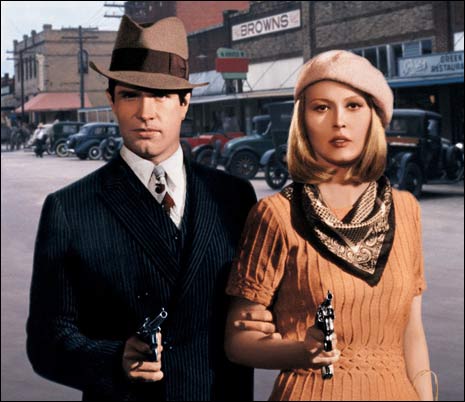
Bonnie and Clyde


There is a moment in "Bonnie and Clyde'' when Bonnie, frightened and angry, runs away from Clyde through a field of wheat, and as he pursues her, a cloud sweeps across the field and shadows them. Seen in a high, wide-angle shot, it is one of those moments of serendipity given to few movies. Today the cloud could be generated by computers; on the day the scene was filmed in Texas, it was a perfectly timed accident of nature.

The cloud carries foreboding; Bonnie and Clyde are doomed, and uneasily realize it. Not long after that scene, Bonnie has a final reunion with her mother. By then Bonnie Parker (Faye Dunaway) and Clyde Barrow (Warren Beatty) are famous outlaws, celebrated in the press as populist bank robbers in an America gripped by the Depression. Bonnie speaks wistfully of marrying Clyde and moving in next door to her mother. "You live within a mile of me, honey, and you'll be dead,'' her mother flatly pronounces.

They would indeed die, in a hail of bullets that permanently changed the way the movies depicted violence. But their lives provided a template that would be used time and again in later films; as the ads put it, "They're young ... they're in love ... and they kill people.'' From "Bonnie and Clyde'' descended "Badlands,'' "Days of Heaven,'' "Thelma & Louise,'' "Drugstore Cowboy,'' "Natural Born Killers'' and countless other movies in which ordinary people were transformed by sudden violence into legend.

"Bonnie and Clyde,'' made in 1967, was called "the first modern American film'' by critic Patrick Goldstein, in an essay on its 30th anniversary. Certainly it felt like that at the time. The movie opened like a slap in the face. American filmgoers had never seen anything like it. In tone and freedom it descended from the French new wave, particularly Francois Truffaut's own film about doomed lovers, "Jules and Jim.'' Indeed, it was Truffaut who first embraced the original screenplay by David Newman and Robert Benton, and called it to the attention of Warren Beatty, who was determined to produce it.

The legend of the film's production has become almost as famous as its heroes. Stories are told about how Beatty knelt at the feet of studio boss Jack Warner, begging for the right to make the film. How Warner saw the original cut and hated it. How the movie premiered at the Montreal film festival, and was roasted by Bosley Crowther of the New York Times. How Warner Bros. determined to dump it in a chain of Texas drive-ins, and how Beatty implored the studio to give it a chance.

How it opened and quickly closed in the autumn of 1967, panned by the critics, receiving only one ecstatic opening-day newspaper review. (Modesty be damned: It was my own, calling it "a milestone in the history of American movies, a work of truth and brilliance'' and predicting "years from now it is quite possible that `Bonnie and Clyde' will be seen as the definitive film of the 1960s.'')

The movie closed, but would not go away. The soundtrack, bluegrass by Flatt and Scruggs, went to the top of the charts. Theodora Van Runkle's berets and maxiskirts for Dunaway started a global fashion craze. Newsweek critic Joseph Morgenstern famously wrote that his original negative review had been mistaken. The movie reopened, went on to become one of Warner Bros.' biggest hits and won 10 nominations (with Oscars for supporting actress Estelle Parsons and cinematographer Burnett Guffey).

But that is only the success story. More important was the impact the film had on the American movie industry. Beatty's willingness to play a violent character with sexual dysfunction was unusual for a traditional 1960s leading man. In a famous Esquire profile by Rex Reed, which appeared as the movie was opening, he was dismissed as a has-been pretty boy. "Bonnie and Clyde'' put him permanently on the Hollywood map.

Beatty and director Arthur Penn cast the movie mostly with unknown stage actors--so successfully that all the major players (Dunaway, Parsons, Gene Hackman, Michael J. Pollard, Gene Wilder) became stars on the basis of this film. Behind the camera, the movie launched the careers not only of Van Runkle, but also of editor Dede Allen (a New Yorker breaking into a closed shop) and production designer Dean Tavoularis, who went on to work on Francis Ford Coppola's "The Godfather'' and "Apocalypse Now.'' And the cinematography of Guffey launched a whole new wave of its own, of films shot and edited in the more impressionistic French style.

Arthur Penn came fresh to the project after a resounding failure ("Mickey One,'' a self-conscious but intriguing art film) also made with Beatty. His later credits included "Night Moves,'' "Alice's Restaurant'' and "Little Big Man.'' Co-writer Robert Benton became an important director ("Kramer vs. Kramer,'' "Places in the Heart''). It's as if that one film sent all those careers cascading down to the present day.

It was a film in which all of the unlikely pieces were assembled at the right time. And more than anything else, it was a masterpiece of tone, in which the actors and filmmakers were all in sync as they moved the material back and forth between comedy and tragedy.

The opening scenes are lighthearted, starting with Clyde's bravado after Bonnie catches him trying to steal her mother's car. She senses in him, instantly, the means of her escape from a boring west Texas town. What he essentially supplies--for her, for the hero-worshipping gang member C.W. Moss (Pollard) and for the hungry newspaper readers -- is the possibility of glamour in lives of drab poverty. "We're the Barrow Gang,'' Clyde says, introducing them at the beginning of a bank robbery so they'll be sure to get credit. And one of the movie's great moments comes as Clyde lends his gun to a dispossessed black sharecropper so he could shoot at a bank's foreclosure sign.

If Clyde offers glamour, Bonnie offers publicity. She writes "The Ballad of Bonnie and Clyde'' and sends it to a newspaper, and she poses for photos holding a machinegun and a cigar. Clyde's brother Buck (Hackman) is more level-headed, more concerned with bank jobs than newspaper headlines. He comes attached to Blanche (Parsons), whose whiny complaints get on Bonnie's nerves (when agents surround one of their hideouts, she runs screaming across the lawn, still holding the spatula she was using to cook supper).

Penn directs the film as a series of set-pieces, which remain in the memory, focused and clear. The Okie camp where homeless farmers, tractored off their lands by the banks, hunch over campfires. Bonnie's sad, overcast, foggy family reunion. The bank robbery that goes all wrong when C.W. stupidly parks the getaway car. The way laughter turns blindingly to violence, as when a stickup ends with a meat cleaver and a sack of flour, or when a getaway ends with a bullet in a bank man's face. The run-in with a state trooper (Denver Pyle) who is made to pose with Bonnie and Clyde, and then unwisely released. The scene where C.W., a gas station attendant, leaves his job and runs off with the gang that's just robbed him. The scene where C.W.'s father effortlessly browbeats his wimpy son for getting a tattoo. And then the slow-motion ballet of the final execution.

Today, the freshness of "Bonnie and Clyde'' has been absorbed in countless other films, and it's hard to see how fresh and original it felt in 1967 -- just as the impact of "Citizen Kane,'' in 1941, may not be obvious to those raised in the shadow of its influence.

When I saw it, I had been a film critic for less than six months, and it was the first masterpiece I had seen on the job. I felt an exhilaration beyond describing. I did not suspect how long it would be between such experiences, but at least I learned that they were possible.

Wednesday, August 5, 2009

Gone With The Wind


"Gone With the Wind'' presents a sentimental view of the Civil War, in which the ``Old South'' takes the place of Camelot and the war was fought not so much to defeat the Confederacy and free the slaves as to give Miss Scarlett O'Hara her comeuppance. But we've known that for years; the tainted nostalgia comes with the territory. Yet as ``GWTW'' approaches its 60th anniversary, it is still a towering landmark of film, quite simply because it tells a good story, and tells it wonderfully well.

For the story it wanted to tell, it was the right film at the right time. Scarlett O'Hara is not a creature of the 1860s but of the 1930s: a free-spirited, willful modern woman. The way was prepared for her by the flappers of Fitzgerald's jazz age, by the bold movie actresses of the period, and by the economic reality of the Depression, which for the first time put lots of women to work outside their homes.

Scarlett's lusts and headstrong passions have little to do with myths of delicate Southern flowers, and everything to do with the sex symbols of the movies that shaped her creator, Margaret Mitchell: actresses such as Clara Bow, Jean Harlow, Louise Brooks and Mae West. She was a woman who wanted to control her own sexual adventures, and that is the key element in her appeal. She also sought to control her economic destiny in the years after the South collapsed, first by planting cotton and later by running a successful lumber business. She was the symbol the nation needed as it headed into World War II; the spiritual sister of Rosie the Riveter.

Of course, she could not quite be allowed to get away with marrying three times, coveting sweet Melanie's husband Ashley, shooting a plundering Yankee, and banning her third husband from the marital bed in order to protect her petite waistline from the toll of childbearing. It fascinated audiences (it fascinates us still) to see her high-wire defiance in a male chauvinist world, but eventually such behavior had to be punished, and that is what ``Frankly, my dear, I don't give a damn'' is all about. If ``GWTW'' had ended with Scarlett's unquestioned triumph, it might not have been nearly as successful. Its original audiences (women, I suspect, even more than men) wanted to see her swatted down--even though, of course, tomorrow would be another day.

Rhett Butler was just the man to do it. As he tells Scarlett in a key early scene, ``You need kissing badly. That's what's wrong with you. You should be kissed, and often, and by someone who knows how.'' For ``kissed,'' substitute the word you're thinking of. Dialogue like that reaches something deep and fundamental in most people; it stirs their fantasies about being brought to sexual pleasure despite themselves. (``Know why women love the horse whisperer?'' I was asked by a woman friend not long ago. ``They figure, if that's what he can do with a horse, think what he could do with me.'') Scarlett's confusion is between her sentimental fixation on a tepid ``Southern gentleman'' (Ashley Wilkes) and her unladylike lust for a bold man (Rhett Butler). The most thrilling struggle in ``GWTW'' is not between North and South, but between Scarlett's lust and her vanity.

Clark Gable and Vivien Leigh were well matched in the two most coveted movie roles of the era. Both were well-served by a studio system that pumped out idealized profiles and biographies, but we now know what outlaws they were: Gable, the hard-drinking playboy whose studio covered up his scandals; Leigh, the neurotic, drug-abusing beauty who was the despair of every man who loved her.

They brought experience, well-formed tastes and strong egos to their roles, and the camera, which cannot lie and often shows more than the story intends, caught the flash of an eye and the readiness of body language that suggested sexual challenge. Consider the early scene where they first lay eyes on one another during the barbecue at Twelve Oaks. Rhett ``exchanges a cool, challenging stare with Scarlett,'' observes the critic Tim Dirks. ``She notices him undressing her with his eyes: `He looks as if--as if he knows what I look like without my shimmy.' ''

If the central drama of ``Gone With the Wind'' is the rise and fall of a sexual adventuress, the counterpoint is a slanted but passionate view of the Old South. Unlike most historical epics, ``GWTW'' has a genuine sweep, a convincing feel for the passage of time. It shows the South before, during and after the war, all seen through Scarlett's eyes. And Scarlett is a Southerner. So was Margaret Mitchell. The movie signals its values in the printed narration that opens the film, in language that seems astonishing in its bland, unquestioned assumptions:

``There was a land of Cavaliers and Cotton Fields called the Old South. Here in this pretty world, Gallantry took its last bow. Here was the last ever to be seen of Knights and their Ladies Fair, of Master and of Slave. Look for it only in books, for it is no more than a dream remembered, a Civilization gone with the wind.''

Yes, with the capital letters and all. One does not have to ask if the Slaves saw it the same way. The movie sidesteps the inconvenient fact that plantation gentility was purchased with the sweat of slaves (there is more sympathy for Scarlett getting calluses on her pretty little hands than for all the crimes of slavery). But to its major African-American characters it does at least grant humanity and complexity. Hattie McDaniel, as Mammy, is the most sensible and clear-sighted person in the entire story (she won one of the film's eight Oscars), and although Butterfly McQueen, as Prissy, will always be associated with the line ``I don't know nothin' about birthin' babies,'' the character as a whole is engaging and subtly subversive.

Remember that when ``GWTW'' was made, segregation was still the law in the South and the reality in the North. That the Ku Klux Klan was written out of one scene for fear of giving offense to elected officials who belonged to it. The movie comes from a world with values and assumptions fundamentally different from our own--and yet, of course, so does all great classic fiction, starting with Homer and Shakespeare. A politically correct ``GWTW'' would not be worth making, and might largely be a lie.

As an example of filmmaking craft, ``GWTW'' is still astonishing. Several directors worked on the film; George Cukor incurred Clark Gable's dislike and was replaced by Victor Fleming, who collapsed from nervous exhaustion and was relieved by Sam Wood and Cameron Menzies. The real auteur was the producer, David O. Selznick, the Steven Spielberg of his day, who understood that the key to mass appeal was the linking of melodrama with state-of-the-art production values. Some of the individual shots in ``GWTW'' still have the power to leave us breathless, including the burning of Atlanta, the flight to Tara and the ``street of dying men'' shot, as Scarlett wanders into the street and the camera pulls back until the whole Confederacy seems to lie broken and bleeding as far as the eye can see.

And there is a joyous flamboyance in the visual style that is appealing in these days when so many directors have trained on the blandness of television. Consider an early shot where Scarlett and her father look out over the land, and the camera pulls back, the two figures and a tree held in black silhouette with the landscape behind them. Or the way the flames of Atlanta are framed to backdrop Scarlett's flight in the carriage.

I've seen ``Gone With the Wind'' in four of its major theatrical revivals--1954, 1961, 1967 (the abortive ``widescreen'' version) and 1989, and now here is the 1998 restoration. It will be around for years to come, a superb example of Hollywood's art and a time capsule of weathering sentimentality for a Civilization gone with the wind, all right--gone, but not forgotten.

Annie Hall


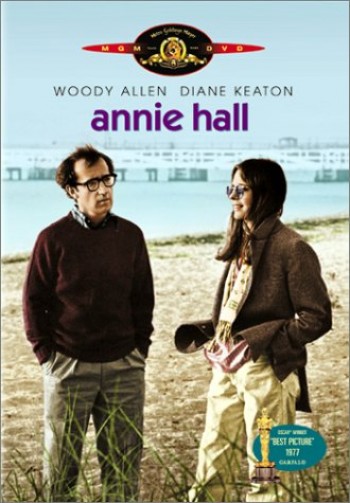
'Annie Hall"contains more intellectual wit and cultural references than any other movie ever to win the Oscar for best picture, and in winning the award in 1977 it edged out "Star Wars," an outcome unthinkable today. The victory marked the beginning of Woody Allen's career as an important filmmaker (his earlier work was funny but slight) and it signaled the end of the 1970s golden age of American movies. With "Star Wars," the age of the blockbuster was upon us, and movies this quirky and idiosyncratic would find themselves shouldered aside by Hollywood's greed for mega-hits. "Annie Hall" grossed about $40 million--less than any other modern best picture winner, and less than the budgets of many of them.

Watching it again, 25 years after its April 1977 premiere, I am astonished by how scene after scene has an instant familiarity. Some of its lines have seeped into the general consciousness; they're known by countless people who never saw the movie, like Jack Nicholson's chicken salad speech from "Five Easy Pieces." For years I've invariably described spiders as being "as big as a Buick," and this movie may be where most people first heard Groucho Marx's comment that he would not want to belong to any club that would have him as a member.

Alvy Singer, the gag writer and stand-up comic played by Allen in the movie, is the template for many of his other roles--neurotic, wisecracking, kvetching, a romantic who is not insecure about sex so much as dubious about all the trouble it takes. Annie Hall, played by Diane Keaton, sets the form for many of Allen's onscreen girlfriends: Pretty, smart, scatterbrained, younger, with affection gradually fading into exasperation. Women put up with a lot in Allen's movies, but at a certain point they draw the line.


Alvy Singer, like so many other Allen characters and Allen himself, accompanies every experience in life with a running commentary. He lives in order to talk about living. And his interior monologues provide not merely the analysis but the alternative. After making love with Annie for the first time, Alvy rolls over, exhausted and depleted, and observes, "As Balzac said, 'There goes another novel'."

Alvy is smarter than the ground rules of Hollywood currently allow. Watching even the more creative recent movies, one becomes aware of a subtle censorship being imposed, in which the characters cannot talk about anything the audience might not be familiar with. This generates characters driven by plot and emotion rather than by ideas; they use catch-phrases rather than witticisms. Consider the famous sequence where Annie and Alvy are standing in line for the movies and the blowhard behind them pontificates loudly about Fellini. When the pest switches over to McLuhan, Alvy loses patience, confronts him, and then triumphantly produces Marshall McLuhan himself from behind a movie poster to inform him, "You know nothing of my work!" This scene would be penciled out today on the presumption that no one in the audience would have heard of Fellini or McLuhan.

"Annie Hall" is built on such dialogue, and centers on conversation and monologue. Because it is just about everyone's favorite Woody Allen movie, because it won the Oscar, because it is a romantic comedy, few viewers probably notice how much of it consists of people talking, simply talking. They walk and talk, sit and talk, go to shrinks, go to lunch, make love and talk, talk to the camera, or launch into inspired monologues like Annie's free-association as she describes her family to Alvy. This speech by Diane Keaton is as close to perfect as such a speech can likely be, climaxing with the memory of her narcoleptic Uncle George falling asleep and dying while waiting in line for a free turkey. It is all done in one take of brilliant brinksmanship, with Keaton (or Annie) right on the edge of losing it.

Because "Annie Hall" moves so quickly, is so fresh and alive, we may not notice how long some of Allen's takes are. He famously likes to shoot most scenes in master shots with all of the actors onscreen all of the time, instead of cutting on every line of dialogue. The critic David Bordwell has an illuminating article in the Spring 2002 issue of Film Quarterly that points out that Allen's average shot length (ASL) ranges high: 22 seconds for "Manhattan" and 35.5 seconds for "Mighty Aphrodite." Bordwell tells me "Annie Hall" has an ASL of 14.5 seconds (he says other 1977 films he clocked had an ASL of from 4 to 7 seconds). By comparison, the recent film "Armageddon" has an ASL of 2.3 seconds, a velocity that arguably makes intelligent dialogue impossible.

Alvy and Annie take a sly delight in their conversational skill; they're attracted to each other not by pheromones but by pacing. In the first conversation they have, after meeting as tennis partners, they fall naturally into verbal tennis:

Alvy: You want a lift?

Annie: Oh, why? Uh, you got a car?

Alvy: No, I was going to take a cab.

Annie: Oh, no. I have a car.

Alvy: You have a car? I don't understand. If you have a car, so then why did you say, 'Do you have a car?' like you wanted a lift?

Annie: I don't, I don't, geez, I don't know. I wasn't. ...I got this VW out there. (To herself) 'What a jerk, yeah. Would you like a lift?'

Alvy: Sure. Which way you goin'?

Annie: Me? Oh, downtown.

Alvy: Down ... I'm going uptown.

Annie: Oh well, you know I'm going uptown too.

Alvy: You just said you were going downtown.

Annie: Yeah, well, but I could ...

This is not merely dialogue, it is a double act in the process of discovering itself. The more we listen to Annie and Alvy talk, the more we doubt they meet many people who can keep up with them When Alvy expresses reluctance to let Annie move in with him, and she complains that her apartment is too small and has bad plumbing and bugs, who but Alvy could take "bugs" as his cue, and observe, "Entomology is a rapidly growing field." And only Annie could interpret this as, "You don't want me to live with you."

Alvy: I don't want you to live with me!? Whose idea was it?

Annie: Mine.

Alvy: Yeah, it was yours, actually, but I approved it immediately.

There are of course other women in Alvy's life, including the Rolling Stone correspondent (Shelley Duvall) who is a Rosicrucian (Alvy: "I can't get with any religion that advertises in Popular Mechanics"). And the liberal Democrat (Carol Kane) who Alvy marries but later splits up with because of their disagreements about the second gun theory of the Kennedy assassination. That Annie Hall is the great love of his life is immediately clear, and the movie is a flashback from the opening monologue in which he sadly notes that a year earlier they were in love; the movie is his analysis of what went wrong, and his answer is, he found happiness, but couldn't accept it. Groucho's line "is the key joke of my adult life, in terms of my relationships with women."

Lore about "Annie Hall" on imdb.com includes the revealing detail that Diane Keaton, who lived with Allen at the time, was born as Diane Hall, and her nickname was Annie. The movie originally contained a murder subplot, entirely dropped; a 140 minute rough cut became a 95 minute film in a process described in editor Ron Rosenblum's book When the Shooting Stops.

Viewing the final cut, I sensed not only how well the remains hold together but how miraculously, since the parts would seem to be an ungainly fit. Consider Allen's astonishing range of visual tactics, including split screens in which the characters on either side directly address one another; a bedroom scene where Annie's spirit gets up during sex to sit, bored, in a chair by the bed; autobiographical flashbacks; subtitles that reveal what characters are really thinking; children who address us as if they were adults ("I'm into leather"); an animated sequence pairing Alvy with Snow White's wicked witch; and the way Alvy speaks directly out of the screen to the audience.

This is a movie that establishes its tone by constantly switching between tones: The switches reflect the restless mind of the filmmaker, turning away from the apparent subject of a scene to find the angle that reveals the joke. "Annie Hall" is a movie about a man who is always looking for the loopholes in perfection. Who can turn everything into a joke, and wishes he couldn't.